Centre Parcs Holiday Village

After a relative quiet period punctuated by the odd contentious wind farm, the Scottish Borders has hit the headlines as a result of the unveiling of two rather ambitious proposals: the Cross Border Connection proposed by Scottish Power Energy Networks and a proposed holiday park by Centre Parcs.

Centre Parcs has announced plans for its first holiday village in Scotland on land to the east of the A7 north of Hawick. The proposals will not be submitted in detail until next year [2025] but will comprise 700 lodges and a range of indoor and outdoor activities, shops, bars, restaurants, an Aqua Sana Forest Spa and the signature indoor water park, the Subtropical Swimming Paradise. It is also proposed to undertaker an extensive programme of afforestation at the 1,000 acres site to create a new woodland area. The company, which currently operates six villages across the UK and Ireland, believes the project will cost between £350m and £400m with between 750 and 800 jobs created during the construction phase. Once completed, Centre Parcs, expects the village to create around 1,200 non-seasonal jobs. It is intended to open a website with an outline of the proposal and updates on the project.

Even before the planning process has started, the leader of Scottish Borders Council, Euan Jardine has described the proposal as an ‘absolutely phenomenal investment’ and ‘fantastic news and great for the area’.

Planning applications for Major developments, such as this proposal require pre-application consultation (PAC) to be carried out between developers and communities. The developers must submit a Proposal of Application Notice (PAN) to the planning authority before any planning application is submitted. This needs to set out the extent of consultation to be carried out and must be agreed by the planning authority before the consultation begins. Once completed, a copy of the pre-application consultation must be submitted with the application. Holiday villages outwith urban areas are also subject to the requirement of an Environmental Impact Assessment.

There is a long way to go, therefore, before this project sees the light of day and when the planning application eventually arrives on the desks of the council’s Planning Department, accompanied by a wealth of information, no doubt there will be a great deal of head scratching.
SPEN Cross Border Connection

After a relative quiet period punctuated by the odd contentious wind farm, the Scottish Borders has hit the headlines as a result of the unveiling of two rather ambitious proposals: the Cross Border Connection proposed by Scottish Power Energy Networks and a proposed holiday park by Centre Parcs.

The Cross Border Connection is a joint development between SP Transmission and National Grid Electricity Transmission. The proposal is driven by the Scottish Government’s commitment to become net zero in all greenhouse gases by 2045, with England and Wales committed to net zero by 2050. The Scottish Government’s target is to deliver 20GW [gigawatts] of additional renewable electricity by 2030 to ensure that 50% of our main energy using sectors is met through renewables by 2030. To meet these targets, the capacity of the electricity network between Scotland and the rest of the UK [England and Wales] needs to be increased. The Cross Border Connection is one of several links being proposed to take renewable power between Scotland and England as part of a £58bn upgrade of the national grid.

SPEN is proposing an overhead power line between 75km and 85km in length, running from a new substation called Gala North, situated in the vicinity of the village of Blainslie, south of Lauder, to a new substation located close to Whitrope, some 13km south of Hawick. The overhead line would comprise a 400kV double circuit line supported by steel lattice towers some 50 metres high [maximum 61 metres] and between 200m and 300m apart.

The preferred route corridor goes south west from the proposed Gala North substation to cross the Gala Water south of Stow and then west of Clovenfords to cross the River Tweed in the vicinity of Thornielee before heading over the Minch Moor Road to cross the Yarrow Valley between Yarrowford and Yarrow village and the Ettrick Valley near Hindhope. The route continues southwards west of the Alemoor Reservoir to cross the Borthwick Water and the Teviot Water [and A7] approximately 6km southwest of Hawick. It then continues south eastwards towards Shankend and then southwards alongside the B6399 to a proposed new Teviot Substation near Whitrope. The preferred route than continues south along the western slopes of the Liddel Valley to the west of Newcastleton to the Scotland-England border south of Kershopefoot.

SPEN has been undertaking a first round of consultation with community councils with a series of exhibitions in village halls from Lauder to Newcastleton. Thirteen public consultation events and presentations to community councils have been undertaken and further presentations and meetings are planned. The consultation period extends until 30 November 2024. Residents along the route and other protestors are already getting organized with the formation of around a dozen community protest groups. On Saturday 9 November, John Lamont, Berwickshire, Roxburgh and Selkirkshire MP chaired a meeting at Caddonfoot Village Hall to allow protestors to raise their concerns with SPEN managers.

It will be next year before a detailed Environmental Impact Assessment is prepared and 2026 before there is a second round of consultation on the detailed route alignment. An application to the Scottish Government under section 37 of the Electricity Act 1989 is not expected before 2028. At this stage, the Scottish Borders Council will be consulted in a similar way in which large scale wind farms are dealt with under section 36 of the Electricity Act. Should the council object at this stage, a public inquiry would be likely so any approval of the proposal would not be likely before 2029.  This story has a long way to run.

Town and Country Planning in the Scottish Borders 1946-1996 [update]

The current image has no alternative text. The file name is: southern-photo-2.jpg

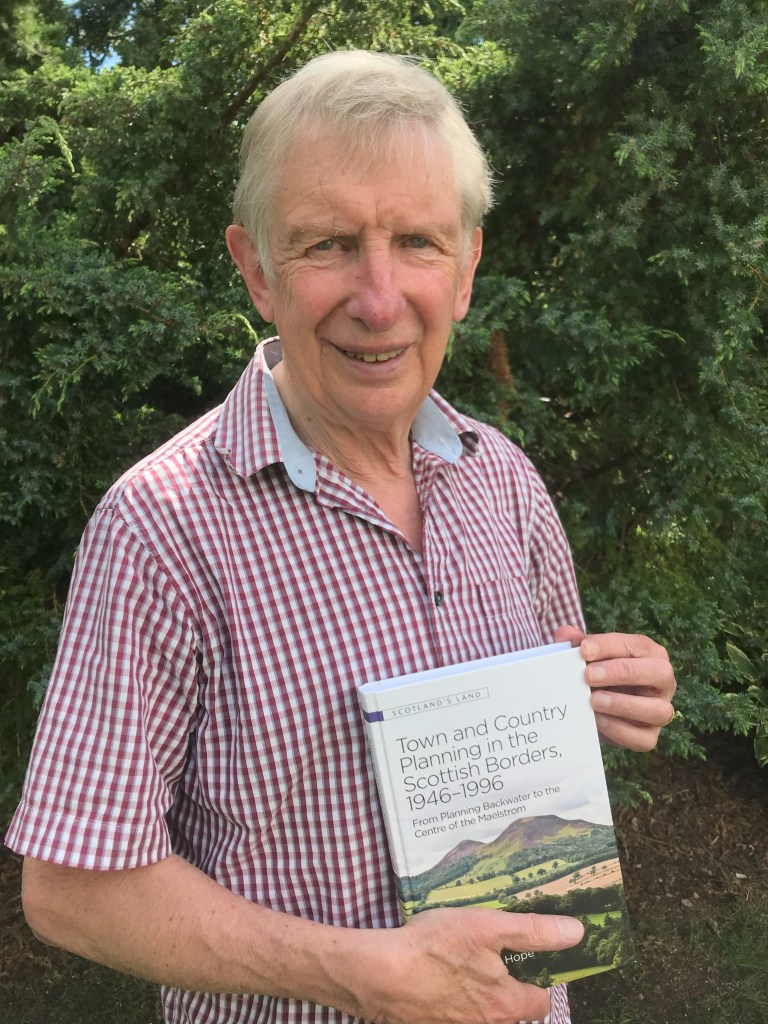
My book entitled Town and Country Planning in the Scottish Borders 1946-1996 was published in hardback by Edinburgh University Press in August 2023 [ISBN 9781399503334]. A paperback version was published in May 2025.

Against the background of the social, economic and political changes of the twentieth century, the book shows how town and country planning emerged from being a fringe activity in Borders local government to become a driving force for change in the region. The book provides a comprehensive appraisal of the changing role of planning in the Scottish Borders during this time and describes how planning evolved from simply a system of land use control to a dynamic, pro-active, multi-disciplined collaboration encompassing not only spatial planning but also economic development and promotion, project design and implementation, urban conservation, rural heritage and countryside management, and environmental planning.

It traces the origins of town and country planning in Britain and the establishment of the planning system in the region. It compares and contrasts the different ways in which the four counties implemented the Town and Country Planning (Scotland) Act 1947 and details the principal policies and proposals in the first county development plans. It describes how planning in the Scottish Borders broadened its horizons in the 1960s as “Planning” in its widest sense took centre stage and more attention was paid by Central Government to the plight of rural areas such as the Scottish Borders with the preparation of the Central Borders Study and the Tweedbank initiative. It details how planning and economic development in the region became inexorably linked.

The book discusses the effect of local government reorganisation in 1975 on planning in the Scottish Borders with the establishment of the Borders Regional Council as a unitary planning authority for the area and explores the key policies and proposals for land use and development in the region’s first structure and local plans. The book examines the challenges and achievements of the 1980s, a period of economic volatility, when the regional council’s role in economic development expanded and partnerships with a range of organisations such as the Scottish Development Agency and the Countryside Commission for Scotland, was key to securing investment and implementing proposals. The 1990s was a period of uncertainty with a number of significant organisational and operational changes amongst Scotland’s principal agencies, and a move towards sustainable economic development. The book details how environmental issues came to the fore and, with the reorganisation of local government in 1996 looming, examines the role of the Planning and Development Department in preparing for the challenges of the twenty-first century. It also looks forward to the impact of the significant changes to the Scottish planning system resulting from the establishment of the Scottish Parliament in 1999 and the subsequent changes to town and country planning in Scotland.

According to Craig McLaren, National Planning Improvement Champion with the Improvement Service and former Director of RTPI Scotland, ‘There are few, if any, books that provide such a detailed history of the practice of town and country planning in Scotland and, given the increasingly divergent planning systems, practice and policy being introduced across different parts of the UK, this book is an essential read for all those interested in the history of town and country planning in Scotland’.

Reviewing the book in the Scottish Geographical Journal, Volume 140, Nos. 1-2, 2024, John Carnie considers that the book is an essential read for all those with an interest in human geography, rural economic development, environmental studies and planning in rural areas. It shows a deep affinity for, and acute knowledge of, the Borders region and offers a detailed and authoritative insight into countryside planning issues. 

I have given a number of talks on my book and shall be giving a talk to the Old Gala Club, Galashiels local history society, in the Volunteer Hall, Galashiels on Wednesday 20th November at 7.30pm.