Centre Parcs Holiday Village

After a relative quiet period punctuated by the odd contentious wind farm, the Scottish Borders has hit the headlines as a result of the unveiling of two rather ambitious proposals: the Cross Border Connection proposed by Scottish Power Energy Networks and a proposed holiday park by Centre Parcs.

Centre Parcs has announced plans for its first holiday village in Scotland on land to the east of the A7 north of Hawick. The proposals will not be submitted in detail until next year [2025] but will comprise 700 lodges and a range of indoor and outdoor activities, shops, bars, restaurants, an Aqua Sana Forest Spa and the signature indoor water park, the Subtropical Swimming Paradise. It is also proposed to undertaker an extensive programme of afforestation at the 1,000 acres site to create a new woodland area. The company, which currently operates six villages across the UK and Ireland, believes the project will cost between £350m and £400m with between 750 and 800 jobs created during the construction phase. Once completed, Centre Parcs, expects the village to create around 1,200 non-seasonal jobs. It is intended to open a website with an outline of the proposal and updates on the project.

Even before the planning process has started, the leader of Scottish Borders Council, Euan Jardine has described the proposal as an ‘absolutely phenomenal investment’ and ‘fantastic news and great for the area’.

Planning applications for Major developments, such as this proposal require pre-application consultation (PAC) to be carried out between developers and communities. The developers must submit a Proposal of Application Notice (PAN) to the planning authority before any planning application is submitted. This needs to set out the extent of consultation to be carried out and must be agreed by the planning authority before the consultation begins. Once completed, a copy of the pre-application consultation must be submitted with the application. Holiday villages outwith urban areas are also subject to the requirement of an Environmental Impact Assessment.

There is a long way to go, therefore, before this project sees the light of day and when the planning application eventually arrives on the desks of the council’s Planning Department, accompanied by a wealth of information, no doubt there will be a great deal of head scratching.

SPEN Cross Border Connection

After a relative quiet period punctuated by the odd contentious wind farm, the Scottish Borders has hit the headlines as a result of the unveiling of two rather ambitious proposals: the Cross Border Connection proposed by Scottish Power Energy Networks and a proposed holiday park by Centre Parcs.

The Cross Border Connection is a joint development between SP Transmission and National Grid Electricity Transmission. The proposal is driven by the Scottish Government’s commitment to become net zero in all greenhouse gases by 2045, with England and Wales committed to net zero by 2050. The Scottish Government’s target is to deliver 20GW [gigawatts] of additional renewable electricity by 2030 to ensure that 50% of our main energy using sectors is met through renewables by 2030. To meet these targets, the capacity of the electricity network between Scotland and the rest of the UK [England and Wales] needs to be increased. The Cross Border Connection is one of several links being proposed to take renewable power between Scotland and England as part of a £58bn upgrade of the national grid.

SPEN is proposing an overhead power line between 75km and 85km in length, running from a new substation called Gala North, situated in the vicinity of the village of Blainslie, south of Lauder, to a new substation located close to Whitrope, some 13km south of Hawick. The overhead line would comprise a 400kV double circuit line supported by steel lattice towers some 50 metres high [maximum 61 metres] and between 200m and 300m apart.

The preferred route corridor goes south west from the proposed Gala North substation to cross the Gala Water south of Stow and then west of Clovenfords to cross the River Tweed in the vicinity of Thornielee before heading over the Minch Moor Road to cross the Yarrow Valley between Yarrowford and Yarrow village and the Ettrick Valley near Hindhope. The route continues southwards west of the Alemoor Reservoir to cross the Borthwick Water and the Teviot Water [and A7] approximately 6km southwest of Hawick. It then continues south eastwards towards Shankend and then southwards alongside the B6399 to a proposed new Teviot Substation near Whitrope. The preferred route than continues south along the western slopes of the Liddel Valley to the west of Newcastleton to the Scotland-England border south of Kershopefoot.

SPEN has been undertaking a first round of consultation with community councils with a series of exhibitions in village halls from Lauder to Newcastleton. Thirteen public consultation events and presentations to community councils have been undertaken and further presentations and meetings are planned. The consultation period extends until 30 November 2024. Residents along the route and other protestors are already getting organized with the formation of around a dozen community protest groups. On Saturday 9 November, John Lamont, Berwickshire, Roxburgh and Selkirkshire MP chaired a meeting at Caddonfoot Village Hall to allow protestors to raise their concerns with SPEN managers.

It will be next year before a detailed Environmental Impact Assessment is prepared and 2026 before there is a second round of consultation on the detailed route alignment. An application to the Scottish Government under section 37 of the Electricity Act 1989 is not expected before 2028. At this stage, the Scottish Borders Council will be consulted in a similar way in which large scale wind farms are dealt with under section 36 of the Electricity Act. Should the council object at this stage, a public inquiry would be likely so any approval of the proposal would not be likely before 2029.  This story has a long way to run.

Town and Country Planning in the Scottish Borders 1946-1996 [update]

The current image has no alternative text. The file name is: southern-photo-2.jpg

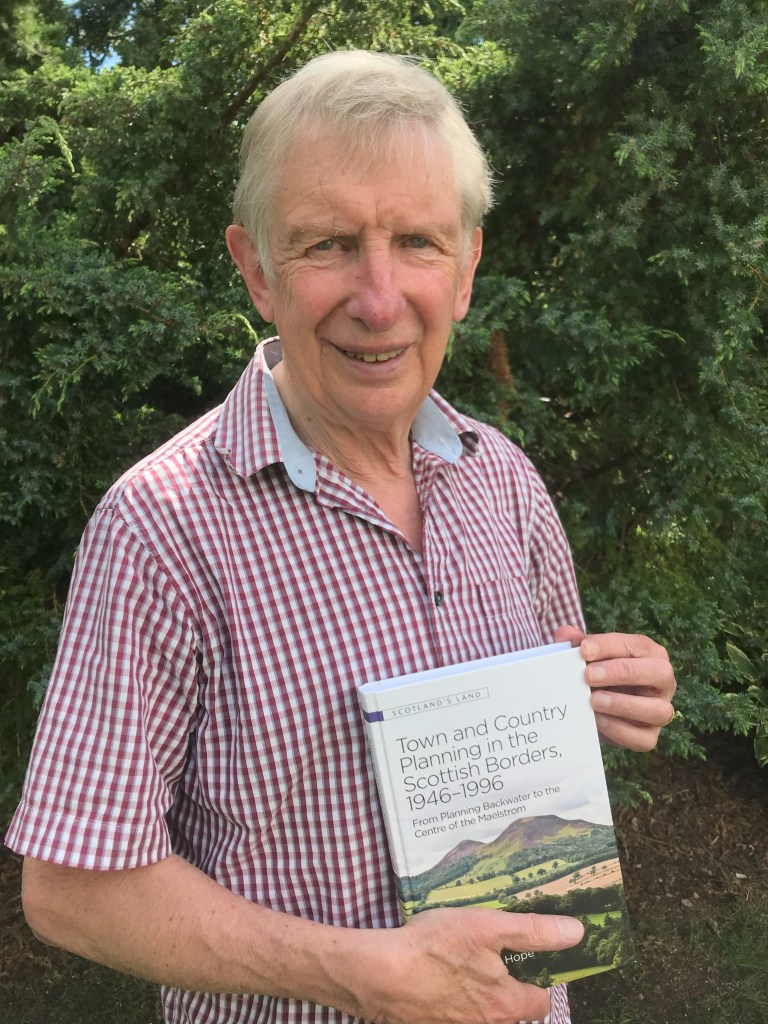
My book entitled Town and Country Planning in the Scottish Borders 1946-1996 was published in hardback by Edinburgh University Press in August 2023 [ISBN 9781399503334]. A paperback version was published in May 2025.

Against the background of the social, economic and political changes of the twentieth century, the book shows how town and country planning emerged from being a fringe activity in Borders local government to become a driving force for change in the region. The book provides a comprehensive appraisal of the changing role of planning in the Scottish Borders during this time and describes how planning evolved from simply a system of land use control to a dynamic, pro-active, multi-disciplined collaboration encompassing not only spatial planning but also economic development and promotion, project design and implementation, urban conservation, rural heritage and countryside management, and environmental planning.

It traces the origins of town and country planning in Britain and the establishment of the planning system in the region. It compares and contrasts the different ways in which the four counties implemented the Town and Country Planning (Scotland) Act 1947 and details the principal policies and proposals in the first county development plans. It describes how planning in the Scottish Borders broadened its horizons in the 1960s as “Planning” in its widest sense took centre stage and more attention was paid by Central Government to the plight of rural areas such as the Scottish Borders with the preparation of the Central Borders Study and the Tweedbank initiative. It details how planning and economic development in the region became inexorably linked.

The book discusses the effect of local government reorganisation in 1975 on planning in the Scottish Borders with the establishment of the Borders Regional Council as a unitary planning authority for the area and explores the key policies and proposals for land use and development in the region’s first structure and local plans. The book examines the challenges and achievements of the 1980s, a period of economic volatility, when the regional council’s role in economic development expanded and partnerships with a range of organisations such as the Scottish Development Agency and the Countryside Commission for Scotland, was key to securing investment and implementing proposals. The 1990s was a period of uncertainty with a number of significant organisational and operational changes amongst Scotland’s principal agencies, and a move towards sustainable economic development. The book details how environmental issues came to the fore and, with the reorganisation of local government in 1996 looming, examines the role of the Planning and Development Department in preparing for the challenges of the twenty-first century. It also looks forward to the impact of the significant changes to the Scottish planning system resulting from the establishment of the Scottish Parliament in 1999 and the subsequent changes to town and country planning in Scotland.

According to Craig McLaren, National Planning Improvement Champion with the Improvement Service and former Director of RTPI Scotland, ‘There are few, if any, books that provide such a detailed history of the practice of town and country planning in Scotland and, given the increasingly divergent planning systems, practice and policy being introduced across different parts of the UK, this book is an essential read for all those interested in the history of town and country planning in Scotland’.

Reviewing the book in the Scottish Geographical Journal, Volume 140, Nos. 1-2, 2024, John Carnie considers that the book is an essential read for all those with an interest in human geography, rural economic development, environmental studies and planning in rural areas. It shows a deep affinity for, and acute knowledge of, the Borders region and offers a detailed and authoritative insight into countryside planning issues. 

I have given a number of talks on my book and shall be giving a talk to the Old Gala Club, Galashiels local history society, in the Volunteer Hall, Galashiels on Wednesday 20th November at 7.30pm.

Local Development Plan 2 (LDP2) Update: July 2023

The Proposed LDP2 was submitted for Examination by Scottish Ministers in July 2022 and four reporters were appointed to assist with its speedy delivery. The Examination commenced in September 2022 and considered 76 outstanding issues arising from 1,351 unresolved representations to the proposed plan. The examination process included a comprehensive series of unaccompanied site inspections and requests for additional information. One hearing session was held to consider the calculation of the housing requirement on which the local plan is based. Account was taken of the new planning guidance from the Scottish Government embodied in National Planning Framework 4 (NPF4) adopted by Scottish Ministers in February 2023. The Report of the Examination has now been submitted to Scottish Borders Council and, unless there are grounds for declining to follow its recommendations [which are limited], the council must make the modifications recommended in the Report of Examination.

The number of modifications proposed is considerable. Perhaps of most interest to the general public will be the decision of the Reporter(s) in relation to the proposed housing at Netherbarns, Galashiels [Issue 35]. After considering all the evidence, the Reporter considers that the allocation of the site at Netherbarns for housing has the potential to have an adverse impact on the setting of Abbotsford House and on its designed landscape. Having concluded that there is no overriding housing need for this allocation, the Reporter recommends that the allocation be deleted from the proposed plan.  No doubt the supporters of Abbotsford will be celebrating.

In relation to the overall proposals in LDP2 for the allocation of housing sites to meet the housing land requirement [Issue 6], an issue which was the subject of detailed debate at the hearing between the council and the private house builders, the Reporter recommends extensive modifications to Chapter 6 and Appendix 2 of the local development plan. In doing so, the Reporter has determined that the land requirement for the ten-year period 2023/24 to 2032/33 should be 4,800 housing units (480 per year on average). This compares with historical completions during the five-year period 2016/17 to 2020/21 of 288 housing units per year; a considerable increase is proposed. The policy in the LDP therefore is to encourage and facilitate an increased level of housing completions, particularly in respect of affordable housing. In relation to housing land supply, the Reporter recommends the deletion of six sites allocated in the LDP, including Netherbarns, with a total indicative capacity of 106 housing units. The Reporter is satisfied, even with the deletion of these sites, that there is sufficient housing land in the LDP to accommodate the housing land requirement of 4,800 housing units without the need to allocate additional sites besides those identified in the proposed plan. Indeed, there is a large surplus of land which could accommodate in excess of 9,000 housing units. Furthermore, windfall sites, that is sites which have not been identified for housing in the LDP, could provide some 100 house units each year based on the previous ten-year average. In fact, completions on windfall sites have provided over about a third of all completions over the past ten years.

Twelve new sites are allocated in the LDP with an indicative capacity of over 400 housing units, including the site at Burnhead, Hawick [AHAW1027], a site previously considered for industrial development. Land to the northeast [BHAW1001] and to the east [BHAW1004] is now allocated for business and industry. It is noted in the Report of the Examination that the owners/tenants of the land remain opposed to the allocation of land at Burnhead for housing/industry. Burnhead was first identified as a potential industrial site back in the 1970s and over a fifteen year period the Borders Regional Council attempted to purchase the land for development to no avail [see my book on Town and Country Planning in the Scottish Borders 1946-1996]. Will Scottish Borders Council be any more successful in enabling the development of this site.

There is much more to disseminate in the Report of Examination, which is now available to view on the DPEA website and should be made available on the Council’s own website. In terms of the Vision, Aims and Spatial Strategy of the Plan, there is little change. The Report makes no changes to the spatial strategy although representations were submitted objecting to the concentration of development in the three strategic development areas and to the concentration of improved connectivity on the links to the north and south without any reference to improving east-west connectivity. In relation to sustainability and climate change [paragraph 4.7], the Report emphasises the continuing need to reduce private vehicular travel, which will indeed be very difficult for many Borderers. In relation to renewable energy, the Government’s adoption of NPF4 has implications for the council’s policies on renewable energy. The council’s 2018 Supplementary Guidance on Renewable Energy will, on the adoption of LDP2, have no development plan status. This guidance may still be used in the assessment of renewable energy proposals but as the national policy context within which it was prepared has been superseded, some aspects of the guidance is no longer applicable. In relation to policy ED9, the Reporter considers that referring to wind turbines as contentious, and highlighting the need for careful scrutiny of applications for 200 metre high turbines is not helpful within the context of addressing climate change and meeting renewable energy targets. The Reporter considers that the wording of policy ED9 can no longer be described as “robust” or up to date. Consequently, policy ED9 has been replaced and will now indicate that development proposals for all forms of renewable, low-carbon and zero emissions technologies will be supported and will be assessed in accordance with NPF4 Policy 11, paragraphs b) to f) and other provisions of NPF4. Much more emphasis, therefore, has been placed on national planning guidance in the assessment of renewable energy proposals, including wind farms.

There is much more to digest in this comprehensive Report of Examination of LDP2 and no doubt, in due course, Scottish Borders Council will publish its response to the Report of Examination by the Council’s Planning Officer. I am looking forward to seeing it.

Town and Country Planning in the Scottish Borders 1946-1996

Published by Edinburgh University Press, this book studies how the practice of town and country planning in the Scottish Borders changed over a fifty-year period from 1946 to 1996. The focus of the book is on an area which encompasses the historic counties of Peeblesshire, Roxburghshire, Selkirkshire and Berwickshire; an area synonymous with woven cloth [tweed] knitwear and agriculture. This area has a rich past but the peaceful tranquillity of its landscape gives little indication of the challenges faced by the area as a result of the decline in its traditional industries and the loss of population after 1891.

Against the background of the social, economic and political changes of the twentieth century, the book shows how town and country planning emerged from being a fringe activity in Borders local government to become a driving force for change in the region. The book provides a comprehensive appraisal of the changing role of planning in the Scottish Borders during this time and describes how planning evolved from simply a system of land use control to a dynamic, pro-active, multi-disciplined collaboration encompassing not only spatial planning but also economic development and promotion, project design and implementation, urban conservation, rural heritage and countryside management, and environmental planning.

The book describes the principal characteristics of the Scottish Borders in terms of its development prior to the twentieth century. It traces the origins of town and country planning in Britain and the establishment of the planning system in the region. It compares and contrasts the different ways in which the four counties implemented the Town and Country Planning (Scotland) Act 1947 and details the principal policies and proposals in the first county development plans. It describes how planning in the Scottish Borders broadened its horizons in the 1960s as “Planning” in its widest sense took centre stage and more attention was paid by Central Government to the plight of rural areas such as the Scottish Borders with the preparation of the Central Borders Study and the Tweedbank initiative. It details how planning and economic development in the region became inexorably linked.

The book discusses the effect of local government reorganisation in 1975 on planning in the Scottish Borders with the establishment of the Borders Regional Council as a unitary planning authority for the area and explores the key policies and proposals for land use and development in the region’s first structure and local plans. The book examines the challenges and achievements of the 1980s, a period of economic volatility, when the regional council’s role in economic development expanded and partnerships with a range of organisations such as the Scottish Development Agency and the Countryside Commission for Scotland, was key to securing investment and implementing proposals. The 1990s was a period of uncertainty with a number of significant organisational and operational changes amongst Scotland’s principal agencies, and a move towards sustainable economic development. The book details how environmental issues came to the fore and, with the reorganisation of local government in 1996 looming, examines the role of the Planning and Development Department in preparing for the challenges of the twenty-first century. It also looks forward to the impact of the significant changes to the Scottish planning system resulting from the establishment of the Scottish Parliament in 1999 and the subsequent changes to town and country planning in Scotland.

According to Craig McLaren, Director of RTPI Scotland, ‘There are few, if any, books that provide such a detailed history of the practice of town and country planning in Scotland and, given the increasingly divergent planning systems, practice and policy being introduced across different parts of the UK, this book is an essential read for all those interested in the history of town and country planning in Scotland’.

To obtain a copy, visit edinburghuniversitypress.com/book/9781399503334, use code NEW30 at checkout to save 30%.

Development Planning: January 2023

The current Local Development Plan (LDP1) was adopted in May 2016. The Strategic Development Plan for south east Scotland [SESplan], approved in June 2013, together with LDP1 form the statutory Development Plan for the Scottish Borders. The adoption of LDP1 included the requirement to produce Supplementary Guidance on Housing Land, in order to meet the additional requirement of 916 houses, and on Renewable Energy. The Supplementary Guidance on Housing Land was formally Adopted in November 2017 following submission to Scottish Ministers for scrutiny. The Supplementary Guidance on Renewable Energy was formally adopted in July 2018.The Scottish Government’s policy as stated in Scottish Planning Policy (SPP), published June 2014, states that the Planning Service should be plan-led with plans being up-to-date and relevant. Local Development Plans are intended to guide development for 10 years. It could be 2024 before the replacement local development plan (LDP2) is formally adopted and replaces LDP1.

The Proposed LDP2, was presented to Scottish Borders Council way back in September 2020 and was then placed on deposit for representations. In excess of 1000 responses were received, this being over double the number received at the same stage during the production of LDP1. It was March 2022, partly as a result of the COVID Pandemic, before a report was presented to the council on the representations received, and the council’s response to each of the matters raised in representations was agreed. The Proposed LDP2 was submitted for Examination by Scottish Ministers in July 2022 and Reporters have been appointed to carry out this examination. Four reporters have been appointed to assist with the speedy delivery of the Examination report [See the Scottish Government’s Planning and Environmental Appeals Division File Reference LDP-140-3].

According to the Development Plan Scheme, approved by the Council in November 2022, it is likely to be the summer of 2023 before the examination is completed. At the present time, the examination is progressing on the basis of written submissions and it will be for the lead Reporter to determine whether any formal hearings are required. The Council expects to be in a position to publicise any proposed modifications to the local development plan during the summer and adopt the local development plan in the autumn. It has to be said that this sounds rather optimistic, bearing in mind the scale of the objections that have been aroused by some of the issues, such as the proposed housing development at Netherbarns, Galashiels.

Previous local development plans have been prepared within the framework set out in strategic development plans and the Government’s National Planning Framework. National Planning Framework NPF3 was published in June 2014 and a replacement draft NPF4 was published in November 2021. The revised draft NPF4 was laid before the Scottish Parliament in November 2022. The principal proposals in NPF4 are designed to: support emerging low-carbon and zero emissions technologies; enable more renewable energy generation; help rural communities grow; and regenerate city and town centres. According to the convenor of RTPI Scotland, it is hoped that this framework will “usher in a new plan-led era that can make sure our towns and cities are greener, healthier and more vibrant”. However, he added that to make this vision of Scotland in 2050 a reality “we need to provide the appropriate resources to our planning departments to prepare local development plans and manage planning applications to guide development appropriately”.

However, the signs are not good. In its analysis of the resources in the planning service, published in December 2022, RTPI Scotland points out that whilst Planning has a vital role to play in moving towards a sustainable, resilient and zero-carbon economy, limited resources and ambition for planning can create a cycle of low-quality development and reduce confidence in the planning system and local authorities. According to the analysis, the Planning Service is the most severely affected of all local government services in terms of budgets with a reduction of 38% since 2010. Planning application fees only cover 66% of their processing costs. Planning department staff has been cut by 25% since 2009.  The Planning (Scotland) Act 2019 will substantially increase the number of duties on planning authorities without providing new resources. Data gathered from planning authorities indicates that only around 8% of planning staff are under 30 years of age whilst over 39% are over 50 years old. The planning sector will require an additional 680-730 new entrants over the next 10-15 years and there is a real need to make sure that we have enough planners to produce development plans and process planning applications to support the post-COVID recovery.

I sincerely hope that the Scottish Government and the Convention of Scottish Local Authorities (COSLA) is listening. Limited resources and a lack of ambition seems to be the order of the day in the local authority planning community.

Planning Progress Report: August 2022

My posts have been somewhat erratic over this past year, mainly because things have been relatively quiet on the planning front in the Scottish Borders. I have also, over the past two or three years been concentrating on my research into the history of town and country planning in the Scottish Borders during the period 1946-96 for a forthcoming book to be published by Edinburgh University Press [in 2023]. For a number of years now, I have been visiting the Heritage Hub in Hawick delving into the planning activities of the four former county councils; Peeblesshire, Roxburgh, Selkirk and Berwickshire, which together with a small part of Midlothian County Council formed the Borders Region in 1975. I have been indebted to a number of former colleagues who have helped me greatly in drawing information together on the planning and development activities of the BRC, the challenges it faced and its achievements during the period 1975-1996. My book will examine how town and country planning [for that is its proper name, although some refer simply to ‘Town Planning’ and others simply to ‘Planning’] evolved in the Scottish Borders from its inception to the demise of the Borders Regional Council in 1996. I shall leave others to deal with Scottish Borders Council.

Returning to the issues of today, I should perhaps draw your attention to the fact that SBC has now submitted its Proposed Local Development Plan [LDP2] to Scottish Ministers for examination of the unresolved issues. In reality it is now for a Reporter [or Reporters] from the Planning and Environmental Appeals Division of the Scottish Government (which is still referred to as the DPEA) to hold hearings/inquiry into the objections received to the submitted local development plan. Apparently, some 1,043 representations were received by the council when the LDP was put out to consultation in November 2020.  It has taken some eighteen months for the council to digest all the representations received and draw them together into 76 groups.  Objections and concerns have been raised in relation to all eight introductory chapters in Volume 1 of the LDP. There are fifty-eight planning policies within Volume 1 and the majority have been the subject of representations. There are also unresolved issues with regard to proposals in fifty-two of the ninety-three settlements in Volume 2 of the LDP. The proposed allocation of a site for housing at Netherbarns, Galashiels has generated a large volume of representations. The submission to the DPEA also highlights a proposed housing allocation in Eddleston, in Peeblesshire, which abuts the holiday hut site at Hatton Knowe, to which objections were received out of time and which the council considers should be disregarded. It will be interesting to see what the Reporter(s) appointed to the local development plan examination decide to do.

All the details relating to the LDP Examination can be found on the DPEA website www.dpea.scotland.gov.uk (Ref. No. LDP-140-3). It will, no doubt, be some considerable time before any examination takes place but progress will be charted on the DPEA’s publicly accessible website. I shall certainly be watching events.

Development Management: January 2022 Update

The past six months have been relatively quiet on the planning front in the Scottish Borders. Most of the applications received in the second half of 2021, some 700 in number, as in the first six months related to the erection of single dwellinghouses and alterations and extensions to dwellinghouses, and works to trees.  The majority of the applications received have been dealt with under delegated powers by the Chief Planning Officer and his staff.  The Planning and Building Standards Committee, in fact, met only four times in the past six months and dealt with five applications, the most noteworthy being the approval of an application to extend the life of the Lurgiescleuch (Pine Burn) Wind Farm, south-west of Hawick from 25 to 40 years. The Local Review Board met five times between August and December 2021 and dealt with some 10 appeals, five of which were upheld, with the Chief Planning Officer’s decision reversed and planning permission granted.

I’ve been looking back over the past three years at the trend in applications received and decided. In 2019, prior to the COVID Pandemic, some 1600 applications were received by the planning department and 1550 applications were decided [one would expect the number of applications received and the decisions made to be evenly balanced but, of course, some applications received are withdrawn before a decision can be made]. In 2020, the number of applications received fell to a little over 1350, as the Pandemic took hold, and the number decided was below 1200, indicating a backlog of applications to be decided. In 2021, the number of applications received bounced back to 1650 applications [even though the Pandemic persisted], but with less than 1400 applications decided, the backlog continues to grow

. As of 31 January, national guidance around working from home has been relaxed enabling a phased return to offices. Surveys of normally office-based staff during the enforced home-working have established that the vast majority are very content with home-working and would like to continue, even when COVID-19 restrictions are eased. SBC does not envisage a notable increase in the number of staff returning to the offices in Newtown St. Boswells.  What this means for the Planning Department and access to officers by the public and applicants is unclear.

If you want to find out more about the applications received and the decisions made, check out the council’s Public Access Portal

In relation to appeals to Scottish Ministers, the appeal against an enforcement notice alleging the use of open amenity land as garden ground and the erection thereon of two sheds and a boundary fence, at 1 Broad Street, Eyemouth was dismissed and the enforcement notice upheld on 8 October 2021 (DPEA Ref: ENA-140-2016). The appeal against the refusal of listed building consent for replacement windows at Rowanside, The Row, Longformacus in Berwickshire was dismissed on 1 November 2021 (DPEA Ref: LBA-140-2006). The appeal against the refusal of the council to grant a Certificate of Lawful Use for the use of the property, Greenloaning at West Linton, for short stay commercial letting remains outstanding (DPEA Ref: CLUD-140-2004 & SBC Ref: 21/00958/CLPU). 

An application for consent under section 36 of the Electricity Act 1989 for a windfarm comprising 45 turbines on land west of Castleweary, south of Hawick, called Faw Side Wind Farm has yet to be decided. A Pre-examination Meeting [virtual] is programmed for 23 February to discuss the timetable for a public inquiry into objections to the proposal.  The majority of the proposed windfarm is within Dumfries and Galloway Council area and the proposed wind farm has prompted widespread opposition from both Scottish Borders Council and Dumfries & Galloway Council and a number of organisations. Interestingly, the Scottish Government published a draft Onshore Wind Policy Statement in October 2021, designed to meet its plans to more than double Scotland’s onshore wind capacity by 2030.  According to Michael Matheson, the ‘Net Zero and Energy Secretary’ onshore wind is one of the most cost-effective forms of large-scale electricity generation and is vital to Scotland’s future energy mix. There is a clear expectation that the region will deliver further capacity through the re-powering of existing sites and/or new windfarms. Many of the most acceptable/appropriate sites have been developed and there are landscape capacity concerns in relation to large areas of the Borders. This document was considered by SBC at its meeting in January 2022 when a comprehensive response was agreed. Reading the response, it is not immediately clear where the council stands on the prospect of larger and/or more wind turbines in the region other than the principle ‘of the right development in the right place’; that the environmental and landscape qualities of the Borders should not be adversely prejudiced.  I await the results of the Scottish Government’s consultation on onshore wind energy with interest.

On the development planning front, all has been quiet since the publication of the Proposed Local Development Plan in the Autumn of 2020. The period for representations on the Proposed LDP ran to 25 January 2021 [a year ago], since when nothing has been heard. Normally, one would have expected arrangements to have been made by now for the holding of a public examination [inquiry] to allow unresolved representations [objections] to be considered by an independent Reporter from the Scottish Government’s Directorate for Planning and Environmental appeals. Apparently, in excess of 1000 responses were received, testament to the interest in planning in the region [also perhaps a reflection of the dis-satisfaction with certain proposals]. In November 2021, the council published its updated Development Plan Scheme which suggests that the Examination of the Proposed LDP could now be held in the Spring/Summer of 2022, with any proposed modifications resulting from the Examination published during the Winter of 2022, following which the LDP would be adopted in early 2023 [another year’s time].

Scottish Planning Policy states that the Planning Service should be plan-led with plans being up-to-date and relevant. The present Local Development Plan was adopted in May 2016, based on information obtained in 2012 and an Examination in November 2014. The housing element of the LDP adopted in May 2016 was modified in November 2017, on the instructions of the Scottish Ministers, through the preparation of Supplementary Guidance on Housing, which allocated additional land for housing. Is this LDP still up-to-date and relevant? Furthermore, given all that has happened over the past couple of years, including a stand-still in house construction and the latent demand for new housing as evidenced by rising house prices, one wonders whether the new LDP prepared in 2018/2019 will need further revision before it is adopted.

Development Management: July/August 2021 update

In July and August, a total of some 270 applications for planning permission and other consents, including listed building and conservation area consents and applications for works to protected trees, were received.  The vast majority related to the erection of single dwellinghouses and alterations and extensions to dwellinghouses, and works to trees.  In Galashiels, an application has now been received for the demolition of the Abbotsford Arms Hotel and the erection of a drive-thru coffee shop to be operated by Starbucks franchisee Burton and Speke Ltd, seven days a week between 6.00am and 10.00pm (SBC Ref: 21/01380/FUL).  The proposed unit would have both internal and external seating and parking for 17 cars.  A more welcome proposal than previous ideas!

Another interesting application is that for the refurbishment of the spectator stand at Gala Fairydean Club at Netherdale, Galashiels (SBC Ref: 21/01335/LBC). The stand is in poor condition and Historic Environment Scotland welcome the proposals to bring this A-listed building back into use. According to Historic Environment Scotland, “The Gala Fairydean football stand is an outstanding work of Late Modernist Formalism in Scotland. Designed by renowned architect Peter Womersley alongside engineers Ove Arup (1963-65), the building represents part of an international trend toward a more sculptural, aesthetic approach to architecture as opposed to the pure functionalism associated with earlier International Modernism.” The proposed work will be welcomed not only by the purists, who wish to see this building retained as a prime example of the work of Peter Womersley but also by the members of Gala Fairydean Club.  It is a pity that the same approach is not being taken by the owner of another of Peter Womersley’s masterpieces, the Bernat Klein Studio at High Sunderland, near Selkirk.

In Peeblesshire, an application has been submitted under section 36 of the Electricity Act 1898 for an amended wind farm scheme in the Clioch Hills (SBC Ref: 21/01134/S36). A scheme for 18 turbines (115m height to tip) was approved by Scottish Ministers in July 2016 following a public inquiry in May/June 2015.  The developer considers that the approved scheme under-uses the site and the amended scheme comprises 12 turbines with a maximum blade tip height of 149.9m. Will SBC maintain its opposition to the wind farm or consider the amended scheme an improvement and remove its opposition? The council has also been consulted on a proposed wind farm west of Moffat (Rivox Wind Farm), comprising 33 turbines with a maximum blade tip height of 230m (SBC Ref: 21/01129/NECON).  It seems that there is a never-ending production line of onshore wind farms as well as off-shore wind farms. Preparing for COP26?

Check out the council’s Public Access Portal if you want to find out more about the above applications or any other application submitted in the past month.

The number of applications determined by the Chief Planning and Housing Officer under delegated powers in July and August, at 248 decisions, continues to be below the number of applications received.  The backlog continues to grow as a result of COVID-19 restrictions.  In Galashiels, planning permission was granted for phase 2 of the Buckholm Corner residential development, which comprises 69 affordable dwellinghouses for rent by Eildon Housing Association (SBC Ref: 21/00417/FUL). The saga of the use of the residential property Greenloaning on the Loan in West Linton goes on. The latest application for a certificate of lawful use for the use of the property for short stay commercial letting was refused on 18 August 2021 (SBC Ref: 21/00958/CLPU).  No doubt an appeal will be forthcoming (see below).

Eleven applications were refused by the Chief Planning and Housing Officer under delegated powers in July/August: the majority related to the erection of dwellinghouses and ancillary development; one related to the deposit of excavated soil/gravel from a house building operation in a nearby field in Peebles (SBC Ref: 21/00896/FUL); and one related to the siting of a mobile catering van to serve mountain bikers, cyclists etc. in Innerleithen (21/00836/FUL). Appeals to the Local Review Board can be expected!

The Planning and Building Standards Committee has met once in the past two month, on 2 August, when the Committee considered four applications. Planning permission was granted for the extension of Edston Quarry, near Peebles (SBC Ref: 21/00222/FUL), for the erection of 69 dwellings on the site at Buckholm Corner, Galashiels (SBC Ref: 21/00417/FUL); for the erection of a dwellinghouse and detached barn at Eckford Moss Cottage, near Kelso (SBC Ref: 21/00293/FUL); and for the erection of over-night accommodation for dogs and a cabin for staff use at a canine care centre at Newlands, north of Hawick (SBC Ref: 21/00687/FUL).

The Local Review Body (LRB) met on 12 July and overturned two decisions by the Chief Planning Officer to refuse planning permission for: (i) replacement windows and door at Linden Causewayend, Ancrum (SBC Ref: 21/00008/RREF); and (ii) the erection of a dwellinghouse at The Old Barn, Westwater, West Linton (SBC Ref: 21/00010/RREF) and granted planning permission for both developments.  At its meeting on 16 August, the LRB overturned three decisions by the Chief Planning Officer to refuse planning permission for: (i) the erection of a dwellinghouse at Dogcraig Cottage, Scotsmill, Peebles (SBC Ref: 21/00007/RREF); (ii) the erection of a dwellinghouse at Rachan Woodlands, Broughton in Peeblesshire (SBC Ref: 21/00011/RREF); and (iii) for the use of a site at Acredale Industrial Estate, Eyemouth for business and industry (SBC Ref: 21/00014/RREF).

As predicted an appeal has quickly been submitted to Scottish Ministers against the refusal of the council to grant a Certificate of Lawful Use for the use of the property, Greenloaning at West Linton, for short stay commercial letting (DPEA Ref: CLUD-140-2004 & SBC Ref: 21/00958/CLPU).  An appeal has also been submitted in respect of the refusal of listed building consent for replacement windows at Rowanside, The Row, Longformacus in Berwickshire (DPEA Ref: LBA-140-2006).

In relation to existing appeals to Scottish Ministers, the compulsory purchase order for 2 High Street/12 Market Place, Jedburgh was confirmed on 11 August 2021 (DPEA Ref: CPO-SBD-011).  The appeal against the refusal of advertisement consent for Bill Board signage at the Lidl store in Hawick was dismissed on 16 August and advertisement consent was refused (DPEA Ref: ADA-140-2000).  The appeal against an enforcement notice alleging the use of open amenity land as garden ground and the erection thereon of two sheds and a boundary fence, at 1 Broad Street, Eyemouth remains outstanding (DPEA Ref: ENA-140-2016). A decision is also awaited on the application under Section 36 of the Electricity Act 1989 for an expansion of the Crystal Rig Wind Farm in the Lammermuirs, comprising the addition of 11 turbines to the existing 90 turbines (DPEA Ref: WIN-140-8). 
Development Management: May/June 2021 Update

In May and June, a total of some 285 applications for planning permission and other consents, including listed building and conservation area consents and applications for works to protected trees, were received.  The vast majority related to the erection of single dwellinghouses and alterations and extensions to dwellinghouses, and works to trees. 

The Proposal of Application Notice has now been submitted for the Galashiels Community Campus, including replacement secondary school, community swimming pool and sports facilities (SBC Ref: 21/00850/PAN).  A virtual public exhibition of the proposals will be held online at www.scotborders.gov.uk/galacampus from Thursday 8 July until Thursday 19 August and an unstaffed physical public exhibition will be held at the Galashiels Transport Interchange from Friday 9 July until Thursday 19 august.  Live and interactive online consultation sessions will take place on 28 July between 6.00pm and 9.00pm and on 4 August between 2.00pm and 5.00pm.  To obtain an invitation to either of these events you must register your interest at galacampus@scotborders.gov.uk. See the local press for more details!!

A Proposal of Application Notice has also been submitted for the Peebles Community Campus, (SBC Ref: 21/01034/PAN).  Few details of the proposed public consultation are revealed in the PAN other than the fact that the formal online public event will take place on the week commencing 19 July and be advertised in the Peeblesshire News and Border Telegraph at least 7 days before the event.

A proposal that has also hit the headlines is the application for a grain distillery at the Charlesfield Industrial Estate, near St. Boswells (SBC Ref: 21/00851/FUL).  The facility would use high-quality local cereals and produce 20m litres of alcohol a year for use in blended whisky, gin and vodka.  The £46m project would create 200 construction jobs and 20 permanent jobs. 

Perhaps the most exciting proposal [and topical] is the proposal by Wemyss and March Estates to restore 174ha of blanket bog on two hill sheep farms, Chapelhope and Winterhope, at the top of the Megget and Yarrow Valleys (SBC Ref: 21/00876/PN).  The work will enhance this important area of blanket bog and result in additional carbon capture. A project that is very welcome.

At the other end of the spectrum, in Berwickshire, a request has been made for a Scoping Opinion as to the level of detail required by the planning authority in the proposed Environmental Statement to be submitted in relation to a proposal for mineral extraction over 82ha of land at Lemington Farm, 3km north of Reston (SBC Ref: 21/01083/SCO).  It is proposed to extract 300,000 tonnes of Greywacke per year for an initial period of 20 years, after which the land would be restored to agriculture.

Meanwhile, in Peeblesshire, the Saga of the use of the property Green Loaning on the Loan in West Linton continues, with the submission of an application for a certificate of lawfulness for the use of the property for holiday letting (SBC Ref: 21/00958/CLPU).  The use of the property as a party venue has caused untold annoyance and disquiet to nearby residents for many years.  When will this end or is ‘planning enforcement’ to be found to be a blunt instrument!

Check out the council’s Public Access Portal if you want to find out more about the above applications or any other application submitted in the past month.

The number of applications determined by the Chief Planning and Housing Officer under delegated powers in May and June, at 242 decisions, is again below the number of applications received.  The backlog continues to grow as a result of COVID-19 restrictions. 

Out of almost 250 decisions, perhaps mention should be made of the decision by the Chief Planning Officer to grant planning permission for the siting of 7 static caravans at the Mosspaul Hotel on the A7 close to the border with Dumfries and Galloway.  This historic Inn, a destination for Hawick Common Riding in ‘normal’ times, has had a chequered history in recent years.  Pre-pandemic it had been rented out as a party venue, popular with hen and stag parties, much to the chagrin of the close neighbours.  Colourful descriptions have been voiced of naked gentlemen playing football on the A7 at dead of night!  Planning permission has now been granted for the siting of second-hand caravans on adjoining land, ostensibly for genuine holidaymakers, subject to a number of conditions in relation to the layout and siting of the caravans, the carrying out of a tree survey, the submission of details of the external materials and colour of the caravans, the submission of a detailed landscaping plan, the means of water supply, surface and foul drainage, and the external lighting of the site.  All these details are to be submitted and agreed before the development commences [I did notice said caravans, obtained from another site, scattered about the grounds of the Mosspaul Hotel the last time I passed the location last week!] The occupation of the caravans should be restricted to ‘genuine holidaymakers’ and for individual periods not exceeding four weeks in total within any consecutive period of 13 weeks and a register of holidaymakers is to be kept for inspection by an authorised officer of the council.  I wonder if the council are to employ an officer to specifically ensure that all these conditions are complied with.  Seems like a monumental task to me [it’s a long way from Newtown].  As I have indicated before, planning conditions require to be enforceable so it will be interesting to see if this is achieved here.

Twelve applications were refused by the Chief Planning and Housing Officer under delegated powers in May/June: four related to the erection of dwellinghouses; one related to the extension of a dwellinghouse; two related to replacement windows in dwellinghouses; two related to the installation of signage on a listed building in Kelso; one related to the change of use of office space within Cavalry Park business park to a day centre for the elderly; one related to the change of use of commercial units on Northgate, Peebles into two flats; and one related to the erection of an agricultural machinery dealership premises at Charlesfield Road, St. Boswells.  Appeals to the Local Review Board can be expected!

During the past two months, there has been little activity in terms of meetings of the Planning and Building Standards Committee and the Local Review Board.  On 31 May, the Planning and Building Standards Committee considered one application and granted planning permission for the erection of 2 glamping pods on land at Drummonds Hall, Lauder (SBC Ref: 20/01024/FUL).  On 28th June, the Planning and Building Standards Committee granted planning permission for eight holiday lodges within woodland at Thirlestane Castle, Lauder (SBC Ref: 20/01355/FUL).

On 17 May, the Local Review Body (LRB) considered one application for a review of the decision by the Chief Planning Officer to refuse planning permission for the erection of a boundary fence at 1 Raeburn Lane, Selkirk (SC Ref: 20/01234/FUL).  The LRB, on the casting vote of the Chairman, decided to uphold the decision of the Chief Planning Officer and refused planning permission.  On 14 June, the LRB overturned the decision of the Chief Planning Officer to refuse planning permission for replacement windows at the premises of the Hawick Angling Club at 5 Sandbed, Hawick and granted planning permission subject to conditions (SBC Ref: 20/01236/FUL).  At the same meeting, the LRB upheld the Chief Planning Officers decision to refuse planning permission for the erection of a dwellinghouse on land at The Bungalow, Edington, Chirnside, Berwickshire (SBC Ref: 21/00045/FUL).

Two new appeals have been submitted to Scottish Ministers: (i) against an enforcement notice alleging the use of open amenity land as garden ground and the erection thereon of two sheds and a boundary fence, at 1 Broad Street, Eyemouth (DPEA Ref: ENA-140-2016); and (ii) against the refusal of advertisement consent for Bill Board signage at the Lidl store in Hawick (DPEA Ref: ADA-140-2000).

In relation to existing appeals to Scottish Ministers, decisions on two appeals have been received: on 18 May, the appeal against the non-determination of a planning application for the erection of 22 dwellinghouses on land east of Edinburgh Road, Peebles was dismissed and planning permission refused (DPEA Ref: PPA-140-2088); and on 10 June, the appeal against the refusal of planning permission for the erection of 2 dwellinghouses at 8 Ballantyne Place, Peebles was also dismissed and planning permission refused (DPEA Ref: PPA-140-2087.  In relation to the compulsory purchase order for 2 High Street/12 Market Place, Jedburgh, a report on the [virtual] public local inquiry held on 5 May 2021 has been submitted to Scottish Ministers and a decision is awaited (DPEA Ref: CPO-SBD-011).  A decision is also awaited on the application under Section 36 of the Electricity Act 1989 for an expansion of the Crystal Rig Wind Farm in the Lammermuirs, comprising the addition of 11 turbines to the existing 90 turbines (DPEA Ref: WIN-140-8).