Thomas Arthur Leonard (1864-1948)

Leonard, Thomas Arthur (1864-1948), founder of the Co-operative Holidays Association and Holiday Fellowship, son of Thomas Leonard, clock and watchmaker, was born on 12 March 1864 at 50 Tabernacle Walk, Finsbury, London.  Leonard’s father died when he was only five years old and he was brought up by his mother, Agnes, the daughter of John Campbell, Congregational minister at the nearby Whitefield Tabernacle.  He thus inherited a non-conformist tradition.  Following the death of his father, the family moved to Hackney, during which time Leonard spent some of his schooldays in Heidelberg in south-west Germany.  This gave rise to his interest in International relations.  By 1881, he was living in Eastbourne where his mother ran a lodging house, and where he drifted into employment as a builder’s clerk.  It was in Eastbourne that he became interested in Sunday school work and met his future wife, Mary Arletta Coupe, whom he married on 5 January 1888.  They had a son, Arthur, and a daughter, Jessie.  Arthur, born June 1889, died in 1902 at the age of 12 years.  Jessie, born December 1891, survived him and also played a prominent part in the Holiday Fellowship until her premature death in November 1948, just 4 months after Leonard’s death in July 1948.  His wife, Mary, died the following year, in June 1949.

His leaning towards the Congregational church led him to enrol in the mid-1880s at the Congregational Institute in Nottingham, run by Dr. John Brown Paton, an educational and social crusader.  Paton had a great influence on the direction of Leonard’s future work and this was a turning point in his life.  His training in Nottingham was followed by pastorates in Barrow (1887-1890) and Colne (1890-1894) in Lancashire.  It was in ‘the bleak upland township’ of Colne, as he describes it in his memoirs Adventures in Holiday Making, that Leonard first sought to enhance the lives of artisan and textile industrial workers though the provision of ‘recreative and educational’ holidays as an alternative to the more common annual exodus during Wakes week to Blackpool and Morecambe. 

In June 1891, Leonard took 32 members of his church’s social guild for a three-night holiday to Ambleside in the Lake District.  Its success led to a trip to North Wales in the succeeding year, and the strong support of his mentor, John Brown Paton and the National Home Reading Union (NHRU), founded by Paton in 1889, encouraged Leonard to expand his holiday programme in 1893.  ‘Why not do this for thousands’ Paton is quoted as saying. 

Holidays “Under the auspices of the NHRU” followed whilst Leonard continued with his pastorate at Colne.  The Co-operative Holidays Association was established as a legal entity in 1897 with J B Paton as President and Leonard as General Secretary.  Its objects were “to provide recreative and educational holidays by purchasing or renting and furnishing houses and rooms in selected centres, by catering in such houses for parties of members and guests and by securing helpers who will promote the intellectual and social interests of the party with which they are associated”.

Leonard’s approach to holiday making was influenced by contemporary social and political thought.  He has been described as a Christian Socialist and disciple of Matthew Arnold and John Ruskin.  He also gained inspiration from William Morris, Edward Carpenter and Charles Kingsley.  The term ‘guest-house’ for the accommodation used by the CHA came from Morris’s News from Nowhere.  Lecturers and guides at CHA centres included leading academics and distinguished professionals, such as Canon Hardwicke Rawnsley, who introduced the first parties to the Lake District to the poetry of Wordsworth and the teachings of Ruskin.

Leonard was an enthusiastic member of the fledgling Independent Labour Party and knew many of its leading figures.  He advertised holidays in Labour Prophet, founded by John Trevor, who joined one of the first NHRU groups to Barmouth in 1894.  Philip Snowden and Ramsay MacDonald visited Leonard’s home in Conwy during the First World War.  However, Leonard was by no means uncritical of the ILP.  His main objective was always to further his ideas for the social improvement of working people, particularly young workers, and he was outspoken on such subjects as socialism, betting and liquor reform.  He was also a convinced pacifist who actively supported efforts to maintain International harmony prior to the First World War.

Under Leonard’s management and guidance, the CHA expanded and by 1913 had thirteen British centres catering for over 20,000 guests.  Although foreign travel was not one of its original objectives, once having experimented with a trip to St. Luc in the Valaisian Alps in 1902, the CHA extended its operations across the Channel, with centres in Switzerland, France, Germany, Norway and Denmark.  Together with J B Paton’s son, John Lewis Paton, High Master of Manchester Grammar School, Leonard organised school exchanges between British and German schools, students and young workers in the years leading up to the First World War to encourage International friendship.  German parties were accommodated at CHA centres, members acting as hosts. 

It came as a shock to many members when, in November 1912, Leonard announced his intention to resign from his post with the CHA in order to form a new organisation, the Holiday Fellowship (HF).  Publicly, his reasons were his desire to extend the work begun twenty years before and to make more progress in his International work.  However, personal records in the CHA archive reveal Leonard’s growing dissatisfaction with the General Committee’s desire to improve the quality of centres and its increasing lack of idealism.  Nevertheless, the split was an amicable one, with the HF taking over the CHA’s centre at Newlands in the Lake District and a centre at Kelkheim in Germany.  The objects of the new organisation were similar to those of the CHA, but with a greater emphasis on International relations, and there was no thought of competition between the two organisations.

Leonard established the HF’s first headquarters at Conwy in North Wales in 1914.  He was its General Secretary until 1925 and a member of the General Committee thereafter until 1947.  He was International Secretary from 1925 to 1930, President in 1938/39 and a Vice-President from 1939 until 1947, by which time the HF operated some 30 centres with over 45,000 guests.  Meanwhile, the CHA had also expanded and operated some 25 centres with 30,000 guests.

Leonard joined the Society of Friends shortly after the First World War, the absence of a rigid creed and the freedom for intellectual religious thought which it afforded appealed strongly to him, and he was a member of Colwyn Bay Meeting for almost 30 years, attending Peace meetings on Conwy Quay and in Conwy Town Hall between the wars.

Leonard played a prominent part in the establishment of the Youth Hostels Association, Ramblers’ Association, International Tramping Tours and the Grey Court Fellowship.  He was a Vice-President of the YHA from its inception in 1930.  He was Chairman of the newly-formed National Council of Ramblers’ Federations in 1931 and continued as President of the Ramblers’ Association from its formation in 1938 until 1946.  He was for many years Chairman, and later President, of the Grey Court Fellowship, founded in 1935 to provide holidays for unemployed workers and their families from North East Lancashire.  In his eighties he founded yet another organisation, the Family Holidays Association, formed to convert derelict Government training camps into family holiday homes. 

Leonard was awarded the O.B.E. in the Coronation Honours of May 1937.  He has justly been described as the ‘Father of the modern open-air movement’.  The extent of his influence on the development of countryside leisure is illustrated by the range of organisations represented at his eightieth birthday celebrations on 18 March 1944, attended by almost 100 guests, which included the Co-operative Holidays Association and Holiday Fellowship, the Youth Hostels Association, Ramblers’ Association, Workers Travel Association, Pennine Way Association, National Trust and the Council for the Preservation of Rural England. 

He died at his home ‘Wayside’, Conwy on 19 July 1948, aged 84 years, survived by his wife and daughter, Jessie, and was cremated at a simple Friend’s service at Anfield Crematorium, Liverpool on 22 July 1948.  Memorial plaques were erected in North Wales and the Lake District to commemorate his contribution to the outdoor movement, inscribed with the following epitaph: Believing that “The best things any mortal hath are those which every mortal shares”, he endeavoured to promote “Joy in widest commonalty spread”.  As one obituary states: ‘His fertile imagination, his great powers of persuasion, his friendship and warm heartedness were responsible for the initiation and success of many enterprises which have brought joy, happiness, fellowship and comfort to tens of thousands both in this country and abroad.  He sought no personal gain for himself.’ 
Centre Parcs Holiday Village

After a relative quiet period punctuated by the odd contentious wind farm, the Scottish Borders has hit the headlines as a result of the unveiling of two rather ambitious proposals: the Cross Border Connection proposed by Scottish Power Energy Networks and a proposed holiday park by Centre Parcs.

Centre Parcs has announced plans for its first holiday village in Scotland on land to the east of the A7 north of Hawick. The proposals will not be submitted in detail until next year [2025] but will comprise 700 lodges and a range of indoor and outdoor activities, shops, bars, restaurants, an Aqua Sana Forest Spa and the signature indoor water park, the Subtropical Swimming Paradise. It is also proposed to undertaker an extensive programme of afforestation at the 1,000 acres site to create a new woodland area. The company, which currently operates six villages across the UK and Ireland, believes the project will cost between £350m and £400m with between 750 and 800 jobs created during the construction phase. Once completed, Centre Parcs, expects the village to create around 1,200 non-seasonal jobs. It is intended to open a website with an outline of the proposal and updates on the project.

Even before the planning process has started, the leader of Scottish Borders Council, Euan Jardine has described the proposal as an ‘absolutely phenomenal investment’ and ‘fantastic news and great for the area’.

Planning applications for Major developments, such as this proposal require pre-application consultation (PAC) to be carried out between developers and communities. The developers must submit a Proposal of Application Notice (PAN) to the planning authority before any planning application is submitted. This needs to set out the extent of consultation to be carried out and must be agreed by the planning authority before the consultation begins. Once completed, a copy of the pre-application consultation must be submitted with the application. Holiday villages outwith urban areas are also subject to the requirement of an Environmental Impact Assessment.

There is a long way to go, therefore, before this project sees the light of day and when the planning application eventually arrives on the desks of the council’s Planning Department, accompanied by a wealth of information, no doubt there will be a great deal of head scratching.

SPEN Cross Border Connection

After a relative quiet period punctuated by the odd contentious wind farm, the Scottish Borders has hit the headlines as a result of the unveiling of two rather ambitious proposals: the Cross Border Connection proposed by Scottish Power Energy Networks and a proposed holiday park by Centre Parcs.

The Cross Border Connection is a joint development between SP Transmission and National Grid Electricity Transmission. The proposal is driven by the Scottish Government’s commitment to become net zero in all greenhouse gases by 2045, with England and Wales committed to net zero by 2050. The Scottish Government’s target is to deliver 20GW [gigawatts] of additional renewable electricity by 2030 to ensure that 50% of our main energy using sectors is met through renewables by 2030. To meet these targets, the capacity of the electricity network between Scotland and the rest of the UK [England and Wales] needs to be increased. The Cross Border Connection is one of several links being proposed to take renewable power between Scotland and England as part of a £58bn upgrade of the national grid.

SPEN is proposing an overhead power line between 75km and 85km in length, running from a new substation called Gala North, situated in the vicinity of the village of Blainslie, south of Lauder, to a new substation located close to Whitrope, some 13km south of Hawick. The overhead line would comprise a 400kV double circuit line supported by steel lattice towers some 50 metres high [maximum 61 metres] and between 200m and 300m apart.

The preferred route corridor goes south west from the proposed Gala North substation to cross the Gala Water south of Stow and then west of Clovenfords to cross the River Tweed in the vicinity of Thornielee before heading over the Minch Moor Road to cross the Yarrow Valley between Yarrowford and Yarrow village and the Ettrick Valley near Hindhope. The route continues southwards west of the Alemoor Reservoir to cross the Borthwick Water and the Teviot Water [and A7] approximately 6km southwest of Hawick. It then continues south eastwards towards Shankend and then southwards alongside the B6399 to a proposed new Teviot Substation near Whitrope. The preferred route than continues south along the western slopes of the Liddel Valley to the west of Newcastleton to the Scotland-England border south of Kershopefoot.

SPEN has been undertaking a first round of consultation with community councils with a series of exhibitions in village halls from Lauder to Newcastleton. Thirteen public consultation events and presentations to community councils have been undertaken and further presentations and meetings are planned. The consultation period extends until 30 November 2024. Residents along the route and other protestors are already getting organized with the formation of around a dozen community protest groups. On Saturday 9 November, John Lamont, Berwickshire, Roxburgh and Selkirkshire MP chaired a meeting at Caddonfoot Village Hall to allow protestors to raise their concerns with SPEN managers.

It will be next year before a detailed Environmental Impact Assessment is prepared and 2026 before there is a second round of consultation on the detailed route alignment. An application to the Scottish Government under section 37 of the Electricity Act 1989 is not expected before 2028. At this stage, the Scottish Borders Council will be consulted in a similar way in which large scale wind farms are dealt with under section 36 of the Electricity Act. Should the council object at this stage, a public inquiry would be likely so any approval of the proposal would not be likely before 2029.  This story has a long way to run.

Doncaster Coalite Limited

My father joined his brother, Walter, at the Coalite Plant at Askern in December 1929, at the age of 14 years, employed as a junior draughtsman.  He would take evening classes in engineering drawing at Doncaster Technical College and become the head draughtsman responsible for producing the plans for the expansion of the works.  He would work at the ‘Plant’ for 46 years until his death in December 1975 and eventually rise to become the General Manager of the works, knowledgeable in every aspect of its operation, responsible to Mr. Flack, the managing director.

“Coalite” was a brand of low-temperature coke used as a smokeless fuel. It is the residue left behind when coal is carbonised at 640˚C [1,184˚F]. The process involved heating the coal in vertical retorts for 4 hours. The retorts were arranged in groups known as batteries. Coalite was darker and more friable than high temperature coke. It was easier to ignite, burnt with an attractive flame, and was lighter in weight than coal, making it an ideal fuel for open domestic fire grates. Drawbacks were its tendencies to produce an excessive residue ash, to burn quickly and give off sulphurous fumes.

Coalite was invented by Thomas Parker [1843-1915] in 1904 and patented in 1906. British Coalite Ltd was registered in 1907, with Thomas Parker as a director, with the rights to acquired land, manufacture and deal in Coalite in the United Kingdom. After a great deal of searching, in 1914, British Coalite Ltd. reached an agreement with the Old Silkstone Collieries Ltd., which owned the Old Silkstone Collieries, near Barnsley, to erect the first ‘Coalite’ plant at Barugh, Barnsley.  Progress was slow due to labour shortages during the First World War and it would be 1919 before the Barugh works commenced operations. The Barugh works comprised 20 retorts with a capacity for dealing with 25,000 tons of coal per year. Every ton of coal produced 14cwt. of smokeless fuel, 3gals. of motor spirit, 16gals of oils for burning, lighting and lubrication, 7,000 cubic feet of gas and 20lbs. of sulphate of ammonia.

British Coal Ltd. was taken over by Low Temperature Carbonisation Ltd. in 1917. Charles Parker, the son of Thomas Parker, designed a new works at Barugh to rectify defects in the design of the plant and the inferior material used in the construction of the batteries, which was the best that could be obtained during the war. The existing batteries were entirely demolished leaving standing only the subsidiary plant, comprising the boiler house, gasometers, extractors, and cooling towers etc. Five new batteries were erected; four working and one in reserve, comprising 160 retorts [32 per battery], with a capacity of 75,000 tons per annum. Due to various circumstances, not least the General Strike of 1926, it was 1928 before the new plant came into operation, the same year that the company announced the proposal to erect a similar plant at Askern. The new Coalite plant at Askern, operated by Doncaster Coalite Ltd., a subsidiary of Low Temperature Carbonsation Ltd., was opened on Friday July 5, 1929 by Jenny Lee M.P., at the time the youngest female M.P, who would marry Welsh M.P. Aneurin Bevan in 1934.

Initially at Askern, four batteries were in operation, capable of carbonising 90,000 tons of coal per year. The crude oil, produced as a by-product, was of particularly high quality and was converted into diesel and fuel oil of a high standard. Other spirit was suitable for use in a variety of high efficiency engines. The plant utilised small coal and slack, on average amounting to 49% of the output of the coal mine. Initially, about 100 men were employed at the plant but this number quickly increased to 150. In 1934, four further batteries were added as demand for Coalite increased and uses for its oil by-products expanded. The capacity of the plant was doubled to 180,000 tons of coal per year, yielding 127,000 tons of smokeless fuel (Coalite), and 3,731,000 gallons of oil and petrol.

In 1936, a new manufacturing plant was commissioned at Bolsover, near Chesterfield in Derbyshire; production commenced in November 1936 and the plant was officially opened by the Duke of Kent in April 1937. It was the largest smokeless fuel manufacturing plant in the world. In the same year, another plant was opened at Werntarw, near Pencoed in South Wales. The seams at Werntarw were well-suited for smokeless fuel, aviation petrol and diesel fuel. However, during World War Two, the coal from Werntarw Colliery was requisitioned by the Government and directed to steelworks for use as blast furnace coke and the Coalite works closed, never to re-open after the war. By 1940, twenty squadrons of the RAF were fuelled by Coalite petrol and it was reputed that two battleships were propelled by Coalite diesel. The first petrol pump at a filling station serving petrol made from coal was opened on the Brompton Road in London.

The Coalite plants escaped nationalisation when the Coal Industry Nationalisation Act 1946 came into effect on January 1, 1947. In 1949, the company changed its name from Low Temperature Carbonisation Ltd. to Coalite and Chemicals Company Ltd. to reflect the diversified nature of the business. The demand for Coalite continued to increase through the 1950s as clean air became a priority following the smogs of the early 1950s and the passing of the Clean Air Act in 1956; ‘Coalite’ was licenced as an ‘authorised fuel’. Head Office, which had been in London since 1917, was transferred to Bolsover and there was major expansion of the Bolsover plant. Six new batteries were added at Askern bringing the total to eighteen.

The Barugh plant, inoperative since the end of the Second World War, closed in 1950 and production was concentrated at Bolsover and Askern. During the 1950s and 1960s, the Coalite and Chemicals Company Group consisted of several companies, with Francis Waring as managing director of the holding company. Mr. Flack was managing director of the subsidiary, Doncaster Coalite Ltd, and in charge of the Askern Plant. Expansion of the company continued and in 1965, work commenced on a new works at Grimethorpe colliery, near Barnsley [opened in 1966]. The company celebrated its Golden Jubilee in 1967 and the 1970s saw the Company reach it’s zenith in terms of smokeless fuel production. The Bolsover Plant comprised 24 batteries, Askern 18 batteries and Grimethorpe 36 batteries. A new works was opened at Rossington Colliery in 1972 with 20 batteries. However, there were warning signs with the discovery of North Sea Gas and the switch to gas central heating. In 1973, Grimethorpe’s production capacity was reduced by 12 batteries and production ceased at Rossington in 1975, after only three years in operation.

During the late 1970’s and early 1980’s the Coalite Group expanded and diversified its business. Businesses included builders merchants, car distributors, fuel and oil distributors, solid fuel distributors, specialist vehicle manufacturers (Dormobile Camper Vans), transport and warehousing companies, docks and shipping interests, instrument manufacturers, oil production and exploration and substantial interests in the Falkland Islands. This marked the zenith of the company’s fortunes and in 1989, the company was taken over by Anglo-United, a Chesterfield-based open cast coal mining and coal distribution group. However, the smokeless fuel side of the business continued to shrink through the 1980s and there were several waves of redundancies. The Askern plant closed in 1986, following the 1984-85 miner’s strike, which had major implications for the future of the coal industry. Grimethorpe closed in 1994.

The demise of Anglo-United accelerated through the 1990s, largely as a result of the fact that the smaller company, Anglo-United, had borrowed heavily in order to buy the much larger Coalite Group and had intended to service this debt by asset-stripping Coalite’s many subsidiaries, whilst retaining the core business of solid fuel production. The sell-off did not realise as much cash as was required and weighed down by this debt and with little money for investment the company declined as it faced outside competition in a downturned market. In 2002, Anglo-United was bought by a consortium of local Chesterfield businessmen. Viable assets were moved into separate subsidiaries under the Anglo-United holding company. The remaining debts were left with the much diminished Coalite Chemicals Ltd which went into administration and then receivership, and finding no buyers, closed down finally in 2004, leaving a considerable number of redundant employees with much reduced pensions. The ovens at the Bolsover works continued producing Coalite until the plant closed down in 2004.

Brief History of Norton

Norton is situated on the Magnesian Limestone Belt, a geological and landscape feature comprising a narrow north-south trending escarpment of limestone between the clays, sands and gravels of the Vale of York and Humber Levels to the east and the more elevated Yorkshire Coalfield to the west. The Magnesian Limestone Belt is typified by well-drained and fertile soils ideal for agriculture.  During the medieval period, the area to the east was occupied by waterlogged, inaccessible marshes and the higher ground to the west by Barnsdale Forest, which was associated with the legend of Robin Hood, who preyed upon travellers on the Great North Road (the A1), which runs along the Magnesian Limestone escarpment some 3km west of Norton. 

At the time of the Domesday Survey of 1086, Norton Manor was owned by Ilbert de Laci, Baron of Pontefract, and had a population of 100 persons, solely employed in agriculture.  The Manorial complex, which included a Manor House, chapel, dovecote, moat, fishponds, field system and mill was located on the south bank of the River Went, 1km north of the present village centre.  Norton Priory is believed to have been situated at the north end of Priory Road (or Hall Lane) close to the site of the Manor House, in the area known as Priory Garth.  The priory never grew to be particularly significant and was subsequently demolished following the dissolution of the monasteries in 1588. 

In 1743, the Fellows of St. Catherine’s College, Cambridge became the Lord of the Manor of Norton and, in 1756, obtained a private Act of Parliament empowering it to pull down Norton Hall, at that time described as a ruinous edifice with 35 rooms, and to use the materials to build a farmhouse on the site.  Two farmhouses (Norton Priory and Priory Farm) now occupy the site of the hall and the priory.  A handsome new Manor House was built in the village itself.  At this time, Norton village comprised a number of farms and associated cottages spread over a distance of roughly 2km along a single road running from west to east.  A back lane ran parallel with the main street on its northern side and each of the main street properties had strips of land of an acre or more extending to the back lane.  All the buildings constructed prior to the 1850s were built of limestone obtained from local quarries at the western and eastern ends of the village.  Clay pantile roofs were common.  In the mid-19th century there were at least fifteen farms in the village, in addition to Westfield Farm and Cliff Hill Farm located outside the village to the west, Norton Priory and Priory Farm located near the River Went at the north end of Hall Lane, and Norton Common Farm located on the Doncaster-Selby Road (A19) at the eastern extremity of the parish. 

In addition to the twenty farms located in and around the village in the mid-19th century, Priory Mill, a water-powered corn mill, stood on the banks of the River Went close to Norton Priory.  Norton Windmill, a typical late 18th century tower mill, was located on higher ground to the west of the village.  Originally part of the Campsmount Estate, it continued in operation until the 1880s.  Thereafter, the Windmill House and adjoining buildings were converted into cottages.  The windmill itself lay derelict until the 1970s when it was converted into a house.   “The Folly” stood at the corner of West End Road and Spittlerush Lane (the road to Kirk and Little Smeaton, at the west end of the village.  It was probably built in the 1840s alongside a couple of existing cottages (Lane Ends).  Tradition has it that this three-storied building was built by a young man as a surprise home for his bride-to-be.  Unfortunately, she took an instant dislike to the house and refused to live there, leading to it being known as “The Folly”.  It was demolished in the 1970s.

In the early 19th century, there were a number of ‘Beer Houses’ in the village, usually situated within farm houses.  Such ‘Beer Houses’ as the Forester’s Arms, Travellers’ Rest and the School Boy Inn were established to serve the local agricultural population.  The beer house at Travellers’ Rest Farm would cease during the 1920s.  The Forester’s Arms would have a number of distinguished landlords, including three generations of the Senior family, but closed in 1969 to be replaced by a small housing development.  The School Boy Inn, which dates from before 1822 and was re-built in 1903, continues in operation today.  There were other beer houses; the George and Dragon was located just below the cross roads in the centre of the village, probably in the property that would subsequently be called Woodbine Cottage, the home of my grand-parents after 1920.  The Royal Hotel, located at the cross roads in the centre of the village was built in the 1880s and replaced the George and Dragon.  It must have been one of the earliest brick built properties in the village.  There were at least three Malthouses within the village producing malt for the brewing industry.

The National Society for Promoting the Education of the Poor in the Principles of the Established Church built a school and adjoining school house on Campsall Balk in 1862.  This replaced a school for boys located behind the School Boy Inn; the Parish Room.  Initially, the new school only accommodated boys, girls being educated at a school where Campsall Cottages stand at the corner of Campsall Balk and Church Field Road.  This school closed in 1874, after which both boys and girls were educated at the school on Campsall Balk.  There were two chapels in the village; the Primitive Methodist Chapel located between ‘The Laurels’ and School Boy Farm, built about 1845, and the Wesleyan Chapel, situated behind the School Boy Inn, built in the 1870s.  A church hall (the Mission Room), attached to the Parish Church at Campsall, was built in the 1890s. 

The Parish Church, dedicated to St. Mary Magdalene, is situated within the neighbouring village of Campsall, about a mile to the south of Norton.  The church was founded by Ilbert de Laci of Pontefract, Lord of the Manor, in the late 11th century and replaced an earlier wooden Saxon church.  It was originally built between 1086 and 1160 in cruciform shape and extended in the 15th century when the two side aisles were added, together with the south porch.  It is locally reputed that Robin Hood was married to Maid Marion at Campsall Church, the theory founded on the premise that St. Mary Magdalene is the only possible church in the area that fits the description in the 15th century ballad ‘A Gest of Robyn Hode’ published by Child in the 1890s, which states that Robin Hood built a chapel in Barnsdale that he dedicated to Mary Magdalene.  However, no firm evidence exists for this supposition. 

A station was opened in Norton in 1848 on the Lancashire and Yorkshire Railway’s Knottingley Branch, providing services to Doncaster and Pontefract.  The line subsequently became part of the newly established East Coast Main line with the opening of the branch from Knottingley to Burton Salmon in 1850, which gave access to the York & North Midland Railway’s line from Sheffield to York via Normanton.  However, the opening of a direct line from Doncaster to York via Selby in 1871 saw the end of regular express trains using the route but it remained busy with goods traffic, mainly coal from various collieries along its length and local stopping passenger services until closure to passengers in 1948; 100 years after its opening.  It continues to operate as a freight line and as an alternative route for passenger trains when the main line is under maintenance.  The Hull, Barnsley & West Riding Junction Railway and Dock Company built a line between Hull and Stairfoot, near Barnsley, which opened in 1885 and passed through Smeaton, a couple of miles north of Norton across the River Went, where there was a small station.  This line transported fish from Hull to the coalfield area around Barnsley and coal from the Yorkshire Coalfield to the port of Hull.  The line became part of the London and North Eastern Railway in 1923 and remained a freight line until 1959 when it was closed and dismantled.

The 1841-1911 Censuses provide detailed information about the population of Norton during this period.  In 1851, the population of the village stood at 659 persons; almost two-thirds of the heads of the 148 households were employed directly in agriculture.  Over two-thirds of the heads of households in 1851 were born in Norton and the immediately surrounding villages.  Only eight of the 148 heads of households were born outwith Yorkshire.  The population of Norton remained fairly static for most of the second half of the 19th century, around the 600 mark, although, with increasing mechanisation in farming, the population began to decline after 1871 and by 1911 had shrunk to 516 persons (126 households), by which time less than half the heads of households were employed in agriculture.  Only half of the heads of households were born in Norton and the immediately surrounding villages.

At the start of the 20th century rumours that a colliery was to be sunk near the neighbouring villages of Little Smeaton or Askern led to the speculative erection of a number of rows of red brick terraced houses in Norton to serve the anticipated influx of miners.  Victor Bevan, a builder originally from London, arrived in Norton and took up residence in Norton House (previously called ‘West House’) at the western end of the village.  Bevan built rows of terraced houses (Bevan’s Buildings) at the west and east ends of Norton.

Prior to the First World War, Askern rivalled Harrogate as a Spa resort with spring water with healing properties.  By the late 19th century it had five bath houses around a lake and a Hydro Hotel.  The first pit shafts were sunk during the First World War, and by the 1920s, Askern was dominated by the new colliery and its associated new village of terraced houses.  Its reputation as a Spa resort had disappeared.  The local newspaper, the Doncaster Gazette reported enthusiastically that “The pit will bring in its train better facilities for the district, new housing and new schools for the colliers children and open up the neighbourhood.”  It also reported that” The sinking of the coal pit is having its effect upon the reputation of the place as a spa. Owing to the boring operations at the new pit, Askern has already lost one of its most attractive features, namely the well-filled lake.  The pit sinkers have diverted the springs and now, instead of the visitor finding a sheet of water, he is only able to gaze upon an empty basin of weeds save one patch of sulphurous water in the centre.”  A New Village of colliery houses was built alongside the pit and it was decreed that “Askern would grow into such a town as to be almost unrecognisable as the quiet, sleepy, invalid-haunted health resort, which it had been for the past century”.  How true this became!

With the sinking of Askern Colliery in 1916, over 100 new dwellings were constructed in Norton between 1911 and 1921 and the population of the village more than doubled from a little over 500 persons to 1142 persons.  In the 1920s, further terraced houses were built for private rent and the local council commenced the development of semi-detached houses at Brocco Bank.  Nevertheless, Norton’s core buildings remained its farms and associated rows of workers cottages along the main street, many of which were in a dilapidated condition.  In 1925, a Ministry of Housing report commented that “Several houses are beyond repair, unfit for habitation and need drastic action”.  Many of these houses would remain standing, semi-derelict and largely empty until well after the Second World War, when action would be taken to remove many of these rows of cottages, principally as a result of the widening of the main road through the village as car usage increased.

It is against this background that John William and Margaret Hope, my grandfather and grandmother, together with their five children; Eva (b.1908), Walter (b.1909), Elsie (b.1911), John (b.1913) and George (b.1914), my father, arrived in South Yorkshire in 1916.  They spent a short time at Edlington, south west of Doncaster, where a new colliery Yorkshire Main had been recently established, before moving to Askern, situated 8 miles north of Doncaster.  However, by 1918, they were resident in Norton, in a newly-built terraced house at the east end of the village where three more children, Douglas (b.1918), Margaret (b.1920) and Alfred (b.1922), were born.  In 1923, the family of ten moved to Woodbine Cottage, a house with land near the centre of the village, which had previously been the George & Dragon Inn, a poultry farm and residence of the driver of a horse and trap for hire.  They erected greenhouses on the attached land and created a market garden for the growing of vegetables, soft fruit and flowers, and built a shop next to the house.  My grandfather would tend the market garden whilst my grandmother ran the grocers shop, assisted by her eldest daughter (Eva).  My father (George) would help in the market garden and cycle to the station at Smeaton to collect fish from the daily fish train that ran from Hull to Barnsley and Sheffield.  To find out what happened next, you will have to wait for the next post!

The Hedges of the Wychwoods (1800-1939)

Some months ago, my daughter-in-law, Trudy Hope, née Hedges, asked if I would research her family tree.  Her father Edward Ian Hedges was born in Milton-under-Wychwood in February 1936.  He has spent most of his adult life living in Banbury, and was employed as Clerk of Works at Bloxham School for many years before retiring.  Little did I know that the forbears of Ian (for that is the name he goes by), although mostly lowly agricultural labourers, have played such an important part in the history of the Wychwoods.

Ian’s parents were Ernest Thomas Hedges and Lizzie Rathband.  They married in 1908 and had nine children between 1909 and 1936; Ian was the youngest.  In 1911, they lived at College Farm in Upper Milton where Ernest was a ‘Carter’.  It was usually the job of the ‘carter’ to drive the horse-drawn cart, filled with produce, from the farm to market, probably at Chipping Norton.  Ernest and Lizzie continued to live in Milton throughout the 1920s and 1930s and in 1939 resided at Manor Farm, Upper Milton, at which time Ernest’s occupation (now aged 55) was still described as ‘Farm Carter’.

Ian’s father, Ernest was one of six children born to George Hedges (b.1855) of Upper End, Shipton and Elizabeth Ferriman (b.1855).  Elizabeth Ferriman was from the nearby village of Leafield.  They married in 1882 and resided in Shipton for the next 30 years.  Ernest was born at Upper End, Shipton in 1885 but by 1901, George and Elizabeth Hedges resided in a cottage near the Lamb Inn with five children: Frank (b.1883), Ernest (b.1885), William (b.1887), Lillian (b.1892) and George (b.1895).  Their sixth child, Rose, died less than 1 month old in 1889.  George’s occupation is described as ‘Carter on farm’ in 1901.  In 1911, continuing to reside in Shipton, George (aged 56) was still occupied as a ‘Carter on farm’; their son, William (aged 24), was a ‘Domestic gardener’ and son, George (aged 15), was a ‘Plough Boy’.  Ernest, by this time, was married to Lizzie Rathband and living at Upper Milton employed, like his father, as a ‘Carter’.

Ernest’s elder brother Frank married in 1908 and, residing in Shipton, is described as a ‘Farm labourer’ in 1911.  Frank and his wife, Elizabeth Turner, would move to Chipping Norton after the First World War, where he would be occupied as a ‘Domestic gardener’.  Ernest’s brothers William and George would enlist in the army in the First World War.  Both would join the Oxfordshire and Buckinghamshire Light Infantry, George would join the 2nd Battalion in November 1915 and William the 2nd/4th Battalion in January 1916.  George was mobilized in February 1916 and took part in the first day of the Battle of the Somme on 1 July 1916, in which the British Army suffered over 60,000 casualties; the largest number sustained in a day by the British Army.  The battalions of the Oxfordshire and Buckinghamshire Light infantry saw extensive service during the Battle of the Somme (1 July-18 November 1916).  On 28 July, the 2nd Battalion moved to the front line trenches near Waterlot Farm and sustained heavy casualties at the battle there on 30 July.  George was ‘Killed in Action’ on 31 July 1916.  William died on 27 June 1917 at the Battle of Arras.  Their names are inscribed on the war memorial on the green at Shipton.

Ian’s mother, Lizzie Rathband (b.1889) was the daughter of Edwin and Fanny Rathband.  She was born in Milton, where Edwin and Fanny lived in Hawkes Yard; Edwin employed as an ‘Agricultural labourer’ in 1901 and ‘Mason/labourer’ in 1911.  Fanny Rathband, née Honeybone, Ian’s grandmother was a prominent member of the ‘Ascott Martyrs’.  Prior to marrying Edwin Rathband in 1876, Fanny Honeybone, daughter of John Honeybone and Jane (Newman) lived in the Churchill Arms in Ascott with the Morris family, employed as a servant.

In the famous court case held in Chipping Norton on 21 May 1873, Fanny (aged 16) was named as one of the seven ‘ringleaders’ of the group of 16 women that were found guilty of molesting and obstructing two agricultural workers in the employment of Robert Hambidge of Crown Farm, Ascott.  Along with the other ‘ringleaders’, she was sentenced to 10 days hard labour; the other nine women spent seven days in gaol.  According to the evidence of one of the agricultural workers from the village of Ramsden, taken on by Robert Hambidge because his workers, along with others in Ascott, had gone on strike for better wages, on 12 May 1873 the women harassed the two men on their way to work and prevented them from entering the field they were meant to be working in (hoeing).  Fanny, along with two other women, was accused of pushing one of the men, John Hodgkins, into a hedge and telling him “they would duck us if we went to work”.  The women denied that they had molested or obstructed the men; stating that they had merely talked to them and tried to persuade them not to accept work on the farm.  The two clergymen magistrates did not believe the women and convicted them.

The conviction prompted what was described in the local press as ‘a riot’ later in the day when a large crowd assembled outside the police station at Chipping Norton, where the women had been taken to await transport to Oxford County gaol by train.  Expecting the women to be conveyed from the police station to the train station, agricultural workers from Ascott and other villages and inhabitants of Chipping Norton, assembled to cheer on the women but also made threats that they would attempt to release them.  Stones were thrown at the police station and the adjoining superintendent’s house, breaking every window and many roof tiles, and reinforcements had to be sent for from Oxford.  As the evening wore on, the crowd swelled to over 2,000 persons, mostly men, and it was not until 1.00am that the women were transported by four-horse dray, under police protection, to Oxford.

On their release from the county gaol ten days later, the women were met by a cheering crowd and officials of the Agricultural Workers Union.  They were taken to the Union headquarters and “regaled with a substantial breakfast” before being ceremoniously transported by horse and dray from Oxford to Ascott.  As they passed through villages en route, they were loudly cheered by the local population.  Following their arrival home, an open air meeting was held in Chipping Norton, again attended by between 2000 and 3000 people, at which speeches were given by the leader of the agricultural labourers’ movement and the Union, advocating changes to the Criminal Law Act.  Their legacy is that picketing was made legal in 1874 and the appointment of magistrates from the Church of England ceased.  Their names are remembered on the four seats around the bole of the chestnut tree on the green in Ascott-under-Wychwood.  More information on this episode can be found in Beverley McComb’s book The Ascott Martyrs.

After marrying Edwin Rathband in 1876, Edwin and Fanny had some fourteen children and resided in Hawkes Yard, Milton for the next 40 years.  An agricultural labourer for most of his life, by 1911, Edwin was employed as a ‘Mason’s labourer’.  Edwin died in 1929 and Fanny in 1939, reputedly in the Chipping Norton Workhouse; a mental institution from 1929, which would become the London Road Psychiatric Hospital (Cotshill Hospital) in 1947 before being redeveloped for housing in 1996.

Ernest’s father [Ian’s grandfather], George (b.1855) was the youngest of eight children born to Thomas Hedges (b.1801) and Elizabeth Bishop.  They resided on ‘The Green’ in Shipton in the 1850s and 1860s; Thomas is described as an ‘Agricultural labourer’ in the 1851 and 1861 Censuses.  Thomas died in 1864 and, by the 1870s, Elizabeth with sons Richard and George resided at Upper End, Shipton.

Ian’s great grandfather, Thomas (b.1801) was one of at least fourteen children, including twins, born to Thomas Hedges (b.1773) and Mary (Cole); two of the fourteen children died less than one year old.  Thomas and Mary resided in Aviary Row, Shipton close to Shipton Court.  Thomas died in 1840 and, thereafter, Mary resided with her son Thomas and his wife Elizabeth on ‘The Green’ at Shipton.  Thomas’s brother Richard (b.1819) was one of the Cospatrick casualties.  Richard married Sarah Ann Phipps in 1843 and resided at Lower Milton; Richard employed as an ‘Agricultural labourer’.  They had six children between 1845 and 1859 and by 1861 had moved to ‘The Green’ at Shipton.  In 1871, they resided in Red Horse Lane, Shipton with sons John (b.1851), Thomas (b.1854) and Charles (b.1859).  Their eldest son, Henry (b.1845), married Mary Townsend in June 1870 and emigrated to Canada (Toronto) where Henry was employed as ‘Upholsterer’.  Their three children, William (b.1871), Charles (b.1872) and George (b.1874) were born in Toronto.  However, inexplicitly, they returned home sometime between March and September 1874 and in November 1874, with brother John and his wife Sarah, brothers Thomas and Charles, and their father Richard and mother, Sarah Ann, all eleven of the Hedges family set sail on the Cospatrick for New Zealand.  With them were six members of the Townsend family; Mary’s mother and father, Henry and Ann Townsend, and sister Jane and her husband, George Charter, with their two children, George and Mary Ann.  All seventeen perished in the tragedy that struck the Cospatrick when it caught fire and sank in the South Atlantic, several hundred miles south-west of the Cape of Good Hope, in the early hours of Wednesday 18 November 1874.  The teak-built sailing ship carried 429 emigrants, 43 crew and four independent passengers, 476 people in total; only three of whom, all crew, survived.  A stone drinking fountain on the village green at Shipton, erected in 1877 in their memory, lists the seventeen casualties from Shipton.  The full details of this tragedy and its aftermath can be found in the book Women and children last: the burning of the emigrant ship Cospatrick by Charles R. Clark.

It has been possible to trace Ian’s ancestors further back.  Ian’s great great grandfather Thomas (b.1773) was the son of John Hedges (b.1750) of Shipton.  Research of the Shipton-under-Wychwood parish register by Joan Howard Drake, former archivist of the Wychwoods Local History Society, shows that the Hedges family resided in the parish back to the 16th century.  Although of generally lowly agricultural working class, Hedges are remembered in the memorials to the Ascott Martyrs of 1873 and the Cospatrick Disaster of 1874, as well as on the war memorial to the fallen in the First World War on the green at Shipton.  The name of Hedges will therefore continue to live long in the memory of the inhabitants of Shipton and surrounding villages.

Friendship Holidays Association

Introduction

For a period of forty years, from 1922 until 1961, the Friendship Holidays Association (FHA) provided holidays based on communal and co-operative principles similar to those pursued by two much better-known organisations, the Co-operative Holidays Association (CHA) and the Holiday Fellowship, founded by Thomas Arthur Leonard in 1893 and 1913, respectively.  FHA holidays followed a similar format to those of the CHA and the Holiday Fellowship, with a weekly programme of led walks and excursions, and communal evening entertainment organised by the host and hostess, who were volunteer members.  The form and content of its holiday brochures replicated those of the CHA and Holiday Fellowship.

The FHA was founded in 1922 by Henry C White, a self-made man and staunch Methodist.  Henry C White was born in 1875, the son of Charles White, a general labourer from Buckinghamshire and his wife Elizabeth.  He started work at Waterloo Station as a newsboy with Messrs. W.H. Smith and Son at the age of 13 years.  When his brother, who was in charge of the Charing Cross Station bookstall, was transferred to Penrith, Henry C White accompanied him.  After working there for three years, and then in Preston, Manchester and Liverpool, he became the manager of the W.H. Smith bookstall at Poulton-le-Fylde Station, near Blackpool, in 1896.

He successfully ran the Poulton-le-Fylde bookstall for 20 years until 1916 when he left to become a commercial traveller with the Nestlé Company and then with Barker & Dobson, the Liverpool sweet manufacturer.  Married to Jessie Wells in 1911, and with two daughters, Marjorie and Dorothy, the family moved to Kents Bank, near Grange-over-Sands on the edge of the English Lake District in 1916.

After the First World War, dissatisfied with his life as a commercial traveller, Henry C White gave up his job and the family moved to Prestatyn in North Wales.  There, inspired and guided by T.A. Leonard, who lived close by at the Holiday Fellowship’s centre in Conwy, he rented a boarding school in Penmaenmawr with accommodation for 40 people, for 6 weeks during the summer and advertised it as holiday accommodation.  T.A. Leonard willingly offered Henry C White help and advice about expanding his holiday enterprise without fearing the competition.

The FHA Story

The success of this first venture persuaded Henry C White to rent other properties in Llandudno, Pwllheli and Conwy in North Wales, and the Friendship Holidays Association was born.  The first ‘official’ brochure, for 1922, advertises six guest houses; at Llandudno, Pwllheli and Conwy in North Wales, Seaford Bay near Eastbourne in Sussex, Bray in Ireland, and a hotel in London.  The holidays provided basic accommodation at a cost of 70/- (£3.50) per week.

By the middle of the 1930s, the FHA operated over twenty centres, accommodating some 10,000 guests each year, with guest houses stretching from Paignton in the south-west of England to Ardentinny on the shores of Loch Long in Argyllshire, Scotland.  Most were substantial villas and country houses.  Glyn Garth, situated on the banks of the Menai Straits was one of the FHA’s most prestigious guest houses.  Built in 1851 for wealthy German-born businessman and philanthropist, Salias Schwabe, this imposing building became the official residence of the Bishop of Bangor, Watkin Herbert Williams, in 1899, when it became known as ‘The Bishop’s Palace’.  When he retired in November 1924, the Bishop’s Palace was put up for sale and was purchased by the FHA.  It continued as an FHA centre until 1961 except for a break during the Second World War when it was requisitioned for war purposes.  Its use as an FHA centre ceased on the death of H C White in 1961 and was demolished in 1964 to make way for a block of flats.

The outbreak of the Second World War had a profound effect on the FHA.  With one exception, all the guest houses were requisitioned and were out of commission for the duration of the war; the Bishop’s Palace on Anglesey was still in Government hands in 1947.  The Autumn 1947 newsletter, the first for nine years, welcomed guests to a new dawn for the FHA.  The FHA operated successfully during the 1950s with some thirteen guest houses in Britain and organised holidays to ten destinations in Europe; Belgium, France, Germany and Switzerland.  Many centres were in traditional seaside holiday resorts such as Colwyn Bay, Folkestone, Hornsea, Kingswear, North Berwick, Seaford Bay and Ventnor.  Although originally based on walking holidays and established to ‘foster the love of the open air and countryside’, the emphasis of holidays from the 1950s onwards was very much on excursions to local attractions; castles, abbeys, historic villages, gardens and houses.  However, “Friendship” remained a cornerstone of the FHA’s philosophy.  As holiday programmes state:

At all our centres, guests are asked to assist in maintaining the atmosphere of friendliness, which is one of the principal features of our guest houses.  Games, dancing and impromptu concerts are arranged in the evenings and the Host and Hostess will welcome volunteers to play and sing.  Bring your music with you.  Whist drives also arranged.

The 1960s was a period of dramatic social, economic and cultural change.  The liberalisation of British society, increasing mobility and the phenomenal rise in cheap foreign package holidays posed a serious threat to organisations such as the FHA, which provided holidays based on full board accommodation, as well as to the traditional seaside resorts where many of the FHA’s properties were located.  Increasing regulation and demands for improved facilities threatened the viability of the FHA’s centres.  On the death of Henry C White in 1961, his daughter Dorothy decided that she was unable, on her own, to continue to run the business.  Centres were sold-off to be converted into hotels and apartments or demolished.

Conclusions

On the death of Henry C White in 1961, obituaries echo the generally held view of the membership that he succeeded in his aim of providing holidays that: ‘are opportunities to enrich the mind and develop the personality, and above all expand happiness through friendship’.  Few people now remember Henry C White and the organisation he founded and ran for over forty years but the contribution of the FHA to the growing outdoor holiday industry during the inter-war period and the years immediately following the Second World War should not be under-estimated.  The FHA played a not-insignificant role in providing opportunities for ordinary working people to explore the British countryside in an atmosphere of friendship and fellowship and, in so doing, helped to foster a love of the open-air and countryside amongst an increasingly urban population.

Note:  I am indebted to Elizabeth Brooking, H C White’s grand-daughter for providing me with access to the records of the Friendship Holidays Association, on which this article is based.

Barmouth Disaster 1894

Introduction

The 1st August 2019 marks the 125th anniversary of one of the worst boating disasters on the Mawddach Estuary in North Wales.  In 1894, Barmouth was the destination for holidays organised by the newly-formed Co-operative Holidays Association under the auspices of the National Home Reading Union.  The first holidays in 1893, “Under the auspices of the National Home Reading Union”, were arranged to Ambleside and Keswick in the Lake District.  Holidays were organised by a voluntary committee with J B Paton as Chairman and T A Leonard as Secretary.  University lecturers acted as companion guides on the walks and gave evening talks.  Leonard saw his holiday scheme as a development of his faith; an opportunity to enrich the lives of young working people by opening up the countryside for both physical and spiritual renewal.  Leonard was influenced by contemporary social, philosophical and political thought and gained inspiration from William Wordsworth, John Ruskin and William Morris.  It was from the poetry of Wordsworth that Leonard took the motto for the CHA: “Joy in widest commonalty spread”.  The focus of the holidays, therefore, was on both physical and spiritual fulfilment through communal walking and social activities, religious observance and the prohibition of alcohol.  The CHA attracted women guests from the start, reflecting the changing status of women in the late-nineteenth century.

In 1894, some 350 members of the CHA visited Barmouth in North Wales over a six week period.  From the late 18th century, this coastal town became a favourite stop for the travelling well-to-do, such as Charles Darwin, William Wordsworth, Shelley, Byron and John Ruskin.  The introduction of the railway in 1867 saw the town’s prosperity grow as visitors began to flock to experience its picturesque scenery.  Lodging houses proliferated from the 1870s onwards to cater for the increasing number of working class visitors from the urban areas of England; the Midlands and the North-West.  Sailing and boating on the Mawddach became a popular pastime and the 1891 Census shows that there were some 50 boatmen in the town plying their trade at that time.

At Barmouth, the CHA rented lodging houses at Hendre Villas and on Marine Parade for six weeks in July/August 1894 and between 50 and 60 guests arrived each week.  The poster advertising the holidays at Barmouth, entitled: “A Week by Mountain, Sea and Lake”, advertised holidays for the weeks beginning July 21st & 28th, August 4th, 11th, 18th & 25th.  Meals would consist of a substantial breakfast, lunch in the open air and dinner in the evening.  A ramble was arranged for each day, except Sunday and Wednesday, which would be conducted by a University companion guide, assisted by local “friends”.  Excursions would include walks along the Mawddach Estuary, ascents of Cader Idris and Snowdon, and visits to Aberglaslyn and Cwm Bychan, popular scenic attractions.  In the evenings, there would be half-hour lectures on the geology, history or literature of the neighbourhood, lantern slide shows and music by the friends of the National Home Reading Union.  The cost of a week’s holiday, Saturday to Saturday was 31/6 [£1.57½p], with an additional cost of 3/6 [17½p] for coach and train fares.

The Boat Trip 

During the week commencing 28 July, some 60 guests from the length and breadth of Britain, all members of the National Home Reading Union, stayed at Hendre Villas and at ‘Ty-Fry’ on Marine Parade.  On the Wednesday, their day off from rambling, a party of about twenty guests planned to take boats up the River Mawddach to visit the gold mine at Clogau, near Bontddu.  According to one account from a member of the party, after meeting on the quay and talking to various boatmen, they began to doubt the advisability of making the trip as the wind rose during the day.  However, the majority of the boatmen were happy to take the visitors on a boat trip up the Mawddach in the evening leaving at about 6.00pm (high tide was expected at 8.00pm) rowing up stream on the incoming tide and back on the out-going tide to return by 9.30pm.  Some voiced concerns but, ultimately, nineteen visitors agreed to go on the trip.

The party left the quayside at 6.45pm in three boats; local boatmen, Captain William Jones and Captain Lewis Edwards, were in charge of two of the boats whilst two members of the CHA party, William (Willie) Paton, the youngest son of J B Paton, and Percival Gray, an Oxford University student, who were acting as companion guides, took charge of the third boat.  The estuary was relatively smooth on the journey upstream.  William Jones and Lewis Edwards reached Bontddu at about 7.30pm and the guests went ashore to visit the gold mine.  The boat in the charge of William Paton and Percival Gray continued to Penmaenpool where the party took tea in the hotel.  According to one of the survivors, who was in William Jones’ boat, after visiting the Clogau Gold Mine, the party started back from Bontddu at about half past eight.  The estuary was smooth until they approached ‘Little Island’ [probably near Ynys Dafydd] where there was a sharp curve in the channel.  A combination of rising south-westerly winds and an out-going tide caused big waves to form.  These swamped William Jones’ boat and, notwithstanding the brave efforts of Jones, four occupants of his boat were drowned.  Lewis Edwards landed his boat safely near Caerdeon and the occupants walked the 3 miles safely back along the road to Barmouth.  Meanwhile, the third boat, which was in the charge of William Paton and Percival Gray, following on behind the two other boats, was also swamped and all but one of its seven occupants, were lost.

The harrowing experiences of the survivors attracted national publicity and there were conflicting accounts of the causes of the accident.  The subsequent inquest, held in Dolgellau, returned a verdict of accidental death and discounted the notion portrayed by one witness that the party had been under the influence of drink, having visited the Halfway House at Bontddu.  Both William Jones and Lewis Edwards were commended for their actions during the incident and no blame was attached to the two young companion guides, who were both drowned.

The Victims

Four of the occupants of William Jones’ boat were drowned; John Newman, Herbert Woodworth, Marie Read and Louisa Golightly; William Jones, Frederick Pryor, William Fildes and Maud Reid survived.  Six of the occupants of the boat in the charge of William Pate and Percival Gray were drowned; William Pate, Percival Gray, and Misses Alice Mallinson, Ella Golightly, Sarah Greenwell and Edith Moore.  Only Ethel Packer survived.  Those drowned were all from England; single people, the youngest 17 years old, the eldest, 32 years of age.  William Paton, aged 27, lived and worked in Liverpool; Percival Gray, aged 21, whose home was in Oxford, was a student at New College, Oxford; John Newman, aged 21, came from Dunmow, Essex; Herbert Woodworth, aged 27, from Manchester; Marie Reid, aged 17, from Leeds; Louisa and Ella Golightly, aged 32 and 21 respectively, and Sarah Greenwell, aged 19, were from Durham; Alice Mallinson, aged 30, was from Bradford and Edith Moore, aged 25 from Harrow, Middlesex.

The Aftermath

According to the Cambrian News, “On arriving in Barmouth, relatives were so affected on seeing the dead bodies of their loved ones that the by-standers were affected to tears”.  The bodies of seven of the victims were transported to their respective homes on Friday 3 August, with the exception of that of Mr. Newman, which wasn’t found until the Saturday morning and that of Marie Reid, which was privately interred in Llanaber churchyard on Saturday 4 August.  The body of the tenth victim, Edith Moore was never found.

The boating disaster was a tragedy not only for the victims and their families but also for the Barmouth community.  It led to changes in the registration of boats for hire in Barmouth.  Notwithstanding the 1894 incident, and the resultant publicity, the Co-operative Holidays Association (CHA) continued to visit Barmouth in succeeding years, guests staying at various lodging houses.  In 1911, Orielton Hall on the outskirts of Barmouth was acquired as a guest house and continued in use as a CHA holiday centre until the 1980s.  The CHA would expand to become one of the country’s leading providers of outdoor holidays with some 25 guest houses throughout England, Wales, Scotland and Northern Ireland.

Thomas Arthur Leonard, after establishing the CHA in 1893, would go on to establish the Holiday Fellowship in 1913, which continues to trade as HF Holidays.  Leonard was also instrumental in the establishment of the Youth Hostels Association (England and Wales) in 1930 and the formation of the Ramblers’ Association in 1935, of which he was the first President.  He strongly supported the National Trust and was a stalwart of the campaign for national parks during the 1930s.  He campaigned with Tom Stephenson for a long distance footpath along the crest of the Pennines and was a founder member of the Friends of the Lake District in 1934.  When he died in 1948, he was hailed as the “Father of the open-air movement in this country”.

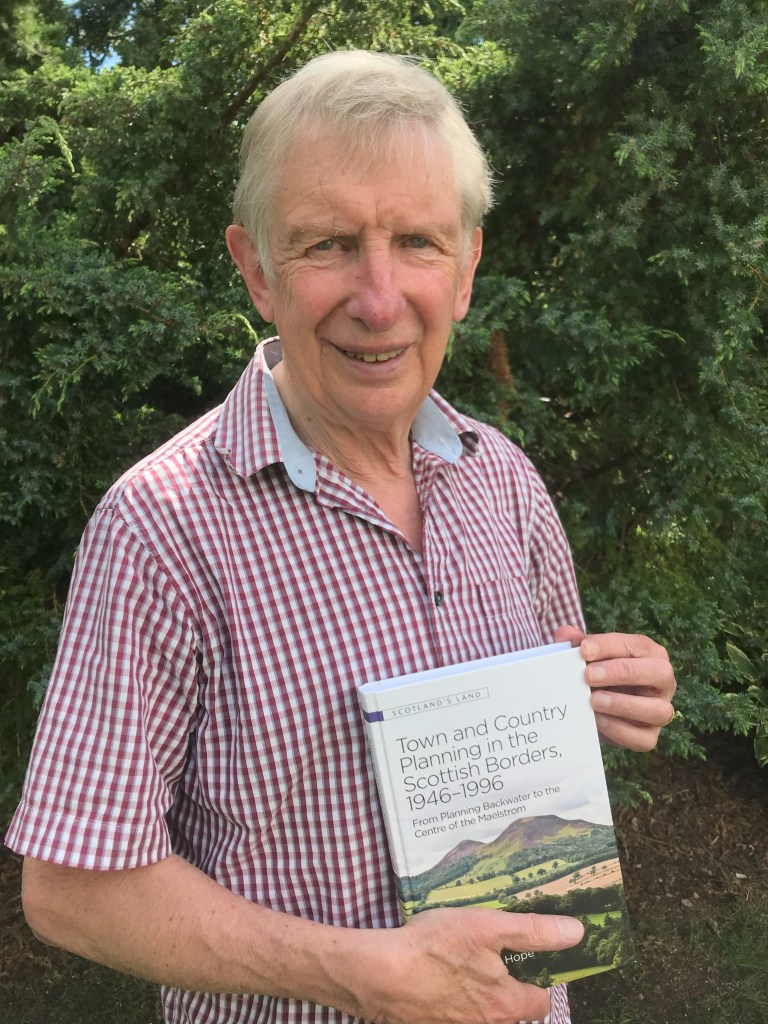
Town and Country Planning in the Scottish Borders 1946-1996 [update]

The current image has no alternative text. The file name is: southern-photo-2.jpg

My book entitled Town and Country Planning in the Scottish Borders 1946-1996 was published in hardback by Edinburgh University Press in August 2023 [ISBN 9781399503334]. A paperback version was published in May 2025.

Against the background of the social, economic and political changes of the twentieth century, the book shows how town and country planning emerged from being a fringe activity in Borders local government to become a driving force for change in the region. The book provides a comprehensive appraisal of the changing role of planning in the Scottish Borders during this time and describes how planning evolved from simply a system of land use control to a dynamic, pro-active, multi-disciplined collaboration encompassing not only spatial planning but also economic development and promotion, project design and implementation, urban conservation, rural heritage and countryside management, and environmental planning.

It traces the origins of town and country planning in Britain and the establishment of the planning system in the region. It compares and contrasts the different ways in which the four counties implemented the Town and Country Planning (Scotland) Act 1947 and details the principal policies and proposals in the first county development plans. It describes how planning in the Scottish Borders broadened its horizons in the 1960s as “Planning” in its widest sense took centre stage and more attention was paid by Central Government to the plight of rural areas such as the Scottish Borders with the preparation of the Central Borders Study and the Tweedbank initiative. It details how planning and economic development in the region became inexorably linked.

The book discusses the effect of local government reorganisation in 1975 on planning in the Scottish Borders with the establishment of the Borders Regional Council as a unitary planning authority for the area and explores the key policies and proposals for land use and development in the region’s first structure and local plans. The book examines the challenges and achievements of the 1980s, a period of economic volatility, when the regional council’s role in economic development expanded and partnerships with a range of organisations such as the Scottish Development Agency and the Countryside Commission for Scotland, was key to securing investment and implementing proposals. The 1990s was a period of uncertainty with a number of significant organisational and operational changes amongst Scotland’s principal agencies, and a move towards sustainable economic development. The book details how environmental issues came to the fore and, with the reorganisation of local government in 1996 looming, examines the role of the Planning and Development Department in preparing for the challenges of the twenty-first century. It also looks forward to the impact of the significant changes to the Scottish planning system resulting from the establishment of the Scottish Parliament in 1999 and the subsequent changes to town and country planning in Scotland.

According to Craig McLaren, National Planning Improvement Champion with the Improvement Service and former Director of RTPI Scotland, ‘There are few, if any, books that provide such a detailed history of the practice of town and country planning in Scotland and, given the increasingly divergent planning systems, practice and policy being introduced across different parts of the UK, this book is an essential read for all those interested in the history of town and country planning in Scotland’.

Reviewing the book in the Scottish Geographical Journal, Volume 140, Nos. 1-2, 2024, John Carnie considers that the book is an essential read for all those with an interest in human geography, rural economic development, environmental studies and planning in rural areas. It shows a deep affinity for, and acute knowledge of, the Borders region and offers a detailed and authoritative insight into countryside planning issues. 

I have given a number of talks on my book and shall be giving a talk to the Old Gala Club, Galashiels local history society, in the Volunteer Hall, Galashiels on Wednesday 20th November at 7.30pm.

Ramblers’ Association

Although T.A. Leonard’s main interest was the provision of holidays in the outdoors, he was a strong advocate of the rambling movement. Living in Conwy in North Wales after 1914, he was a keen member of the Merseyside Ramblers, based in Liverpool and was, for some years, President of the Liverpool and District Ramblers’ Federation, formed in 1922.  It was as President of the Liverpool and District Ramblers’ Federation, and in recognition of the pioneering role he had played in the outdoor movement, that he was asked to chair a conference held at the Holiday Fellowship’s centre, Longshaw in the Derbyshire Peak District, on 26 & 27 September 1931, to consider the establishment of a national body to look after the interests of ramblers.  The meeting was attended by delegates from ten federations: Bolton and District, Glasgow and West of Scotland, Leicestershire, Liverpool, London, Manchester, Nottingham, North Lincolnshire, Sheffield and the West Riding of Yorkshire.  George Mitchell, Secretary of the London Group of Holiday Fellowship Rambling Clubs, acted as secretary.

At this time, there was a measure of conflict between those societies devoted to the protection of footpaths and landscape preservation and those pursuing access to open moorland.  At a previous conference organised by the Council for the Preservation of Rural England (CPRE) in October 1929 to discuss the access to mountains issue, the northern ramblers realised that they were unlikely to receive much support from amenity organisations for an access to mountains campaign.  As a consequence, the Sheffield and District Ramblers’ Federation contacted other northern ramblers’ federations with a view to forming a national federation of ramblers to push the access issue.  However, there was by no means unanimity amongst ramblers’ federations that a national body should be formed.  At a meeting in January 1930, a joint conference of the Sheffield, Manchester and Liverpool and District Federations considered that the time was not yet ripe for the formation of a national federation.

At the subsequent conference in September 1931, chaired by Leonard, the Manchester Federation maintained its doubts about a national body and put forward the motion that two unions should be formed, one for the south and one for the north, with a joint consultative and co-ordinating council.  The Manchester Federation was wary of too much power in a national organisation going to the London Federation.  However, following behind-the-scenes negotiations between T.A. Leonard, who represented the northern federations and George Mitchell from the London Federation, a small sub-committee was formed to work out a resolution.  Whether it was down to Leonard’s negotiating skills or not, when the conference resumed on the second day, Arthur Hewitt, the Manchester Federation representative moved that a National Council of Ramblers’ Federations should be formed and this was carried unanimously.  To reassure the Manchester Federation, it was agreed that District Federations be allowed to organise public meetings to promote access to the mountains.

Leonard was elected as the first Chairman of the National Council of Ramblers’ Federations at the September 1931 conference, an office he held until 1935 when the National Council was reconstituted as the Ramblers’ Association (RA) and he was elected its first President.  During Leonard’s tenure as Chairman of the National Council, the access to mountains campaign continued to be a prime concern of the fledgling organisation.  The National Council was not, however, directly involved in demonstrations such as the “Kinder Trespass” of 14 April 1932, which was prompted by the Sheffield Clarion Club led by G.H.B. Ward and was dominated by Manchester ramblers affiliated to the British Workers’ Sports Federation (BWSF), an appendage of the Communist Party led by Benny Rothman.  The National Council sought to gain access to restricted areas such as grouse moors and water-gathering grounds through negotiation although individual federations organised demonstrations such as the famous series of annual demonstrations held at Winnats Pass, near Castleton in Derbyshire, jointly organised by the Sheffield and Manchester Federations.

Under Leonard’s influence, the National Council was strongly committed to the setting up of national parks. A joint committee of open-air organisations to discuss the establishment of national parks in England and Wales, formed in 1932, included representatives from all three of the organisations Leonard had been involved in founding; the Co-operative Holidays Association, Holiday Fellowship and the National Council of Ramblers’ Federations.  It was following a meeting of this joint committee at Central Hall, Westminster in January 1935, that the Standing Committee on National Parks was formed in December 1935, with members drawn from a range of outdoor and conservation groups, which co-ordinated the campaign for national parks over the next ten years.

Leonard’s period of tenure as President of the Ramblers’ Association from 1935 until 1946 was a controversial period in the RA’s history. The first legislation with which the RA was actively involved was the Access to Mountains Bill 1939, the introduction of which was greeted with great enthusiasm by the RA. However, when a clause was inserted which, in effect, restricted public access to uncultivated land in certain circumstances and made trespass in these cases a criminal offence, the membership voiced vigorous opposition to this “trespass clause” and the RA agreed to oppose the Bill.  Nonetheless, when the Bill became law in January 1940, with the “trespass clause” retained, the RA decided to try and work with the Act and over the next few years this decision was the subject of much controversy.  The RA did eventually resolve to press again for unrestricted access to mountain and moorland at a special meeting held in 1943 but the 1939 Access to Mountains Act was not repealed until the National Parks and Access to the Countryside Act became law in 1949.  However, the RA’s goal of  freedom to roam in the open countryside in England and Wales was not fully achieved until the year 2000 with the passing of the Countryside and Rights of Way Act 2000.

Leonard resigned from the presidency of the Ramblers’ Association in 1946, due to ill-health, to be replaced by John Dower, the architect of the National Parks and Access to the Countryside Act 1949 who had also been Secretary of the Standing Committee on National Parks.

The Ramblers’ Association, re-branded as the “Ramblers” in 2009 comprises some 550 Ramblers groups with over 120,000 members.  The Ramblers continues to promote walking, safeguard footpaths, campaign for increased access to the countryside as well as its protection.